

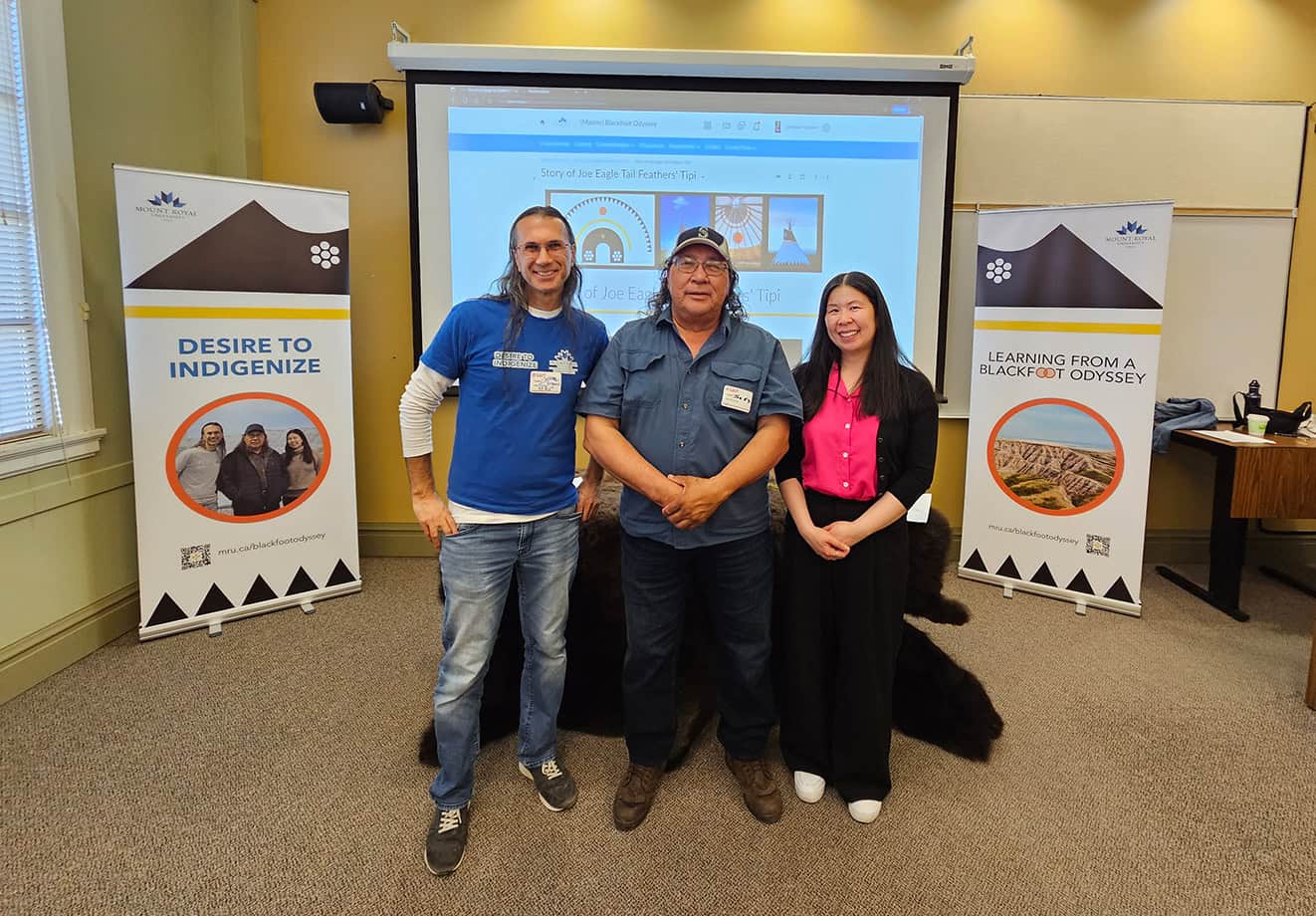

Centered in Blackfoot knowledge, protocol, and lived experience, Blackfoot Odyssey, an Indigenized Brightspace experience designed with permission, reciprocity, and care, was created through collaboration among Assistant Professor Dr. Christopher Grignard, Blackfoot (Kainai) Elder and Niitsitapi ceremonialist Joe Eagle Tail Feathers (Iitsooahp’potah), and eLearning Developer Khethwen Woo. Their work reflects MRU’s commitment to Indigenization and decolonization by ensuring Indigenous voices do not sit at the margins of the learning environment; they are centralized, informing and shaping the work from the start. The result is a D2L Brightspace experience that became not only a digital learning environment, but a sacred and ethical space with impact across learners, institutional practice, and the broader D2L community.
The Challenge
Reimagining Brightspace through treaty relationship
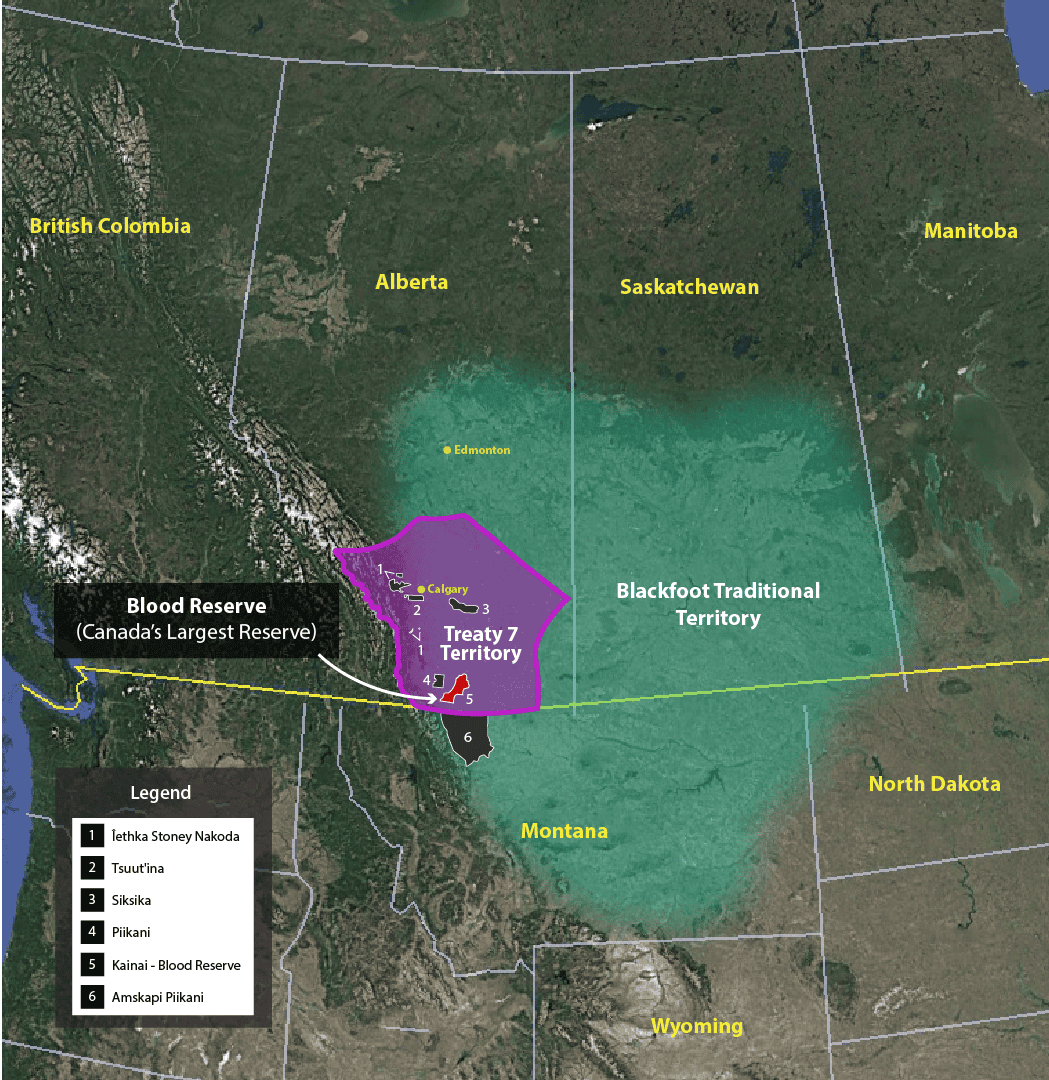
Mount Royal University (MRU) is located on Treaty 7 (Blackfoot Treaty) territory on the hereditary lands of the Blackfoot people [image 1].
© MRU copyright
[image 1] Treaty 7 territory and the traditional lands of the Blackfoot people, where MRU’s work to Indigenize Brightspace explored how digital learning spaces can uphold treaty relationship, ethical space, and Indigenous ways of knowing. Treaty 7 signatories and reserves include Kainai, Siksika, Piikani, Tsuut’ina and Îethka Stoney Nakoda. Amskapi Piikani, although not part of Treaty 7, is a part of the Blackfoot Confederacy.
Through its land acknowledgement, Strategic Plan 2023–2030, and Indigenization and Decolonization Strategic Framework, MRU has committed to creating ethical space where Indigenous and non-Indigenous communities can learn from one another through respect, relationship, and shared understanding.
That commitment raised a deeper challenge for digital learning. The question was not simply how to include Indigenous content in an online course, but whether a learning management system itself could become a place that reflects treaty relationship, ethical space, and Indigenous ways of knowing.
The challenge emerged within a broader context shaped by the Truth and Reconciliation Commission Calls to Action and growing recognition across Canada of the lasting impacts of colonization and residential schools. As the 150th anniversary of Treaty 7 approaches (2027), MRU asked how D2L Brightspace might help uphold the spirit of treaty relationship through respectful partnership, reciprocity, and learning.
When Dr. Christopher Grignard arrived at MRU in 2022, the same year the university implemented D2L as its LMS, he immediately began asking how one could Indigenize a learning management system. In his initial research, he could not locate another example of D2L Brightspace being Indigenized in the way he envisioned. Without an established model to follow, the work would require building new pathways for ethical collaboration, digital learning design, and Indigenous-centred online learning.
Together with Blackfoot (Kainai) Elder and ceremonialist Joe Eagle Tail Feathers and eLearning Developer from MRU’s Academic Development Centre, Khethwen Woo, Grignard began a collaborative effort rooted in relationship, shared responsibility, and long-term learning [image 2].

© MRU copyright
[image 2] Centered in Blackfoot knowledge, relationship and lived experience, the Blackfoot Odyssey collaboration brought together Joe Eagle Tail Feathers, Dr. Christopher Grignard, and Khethwen Woo to reimagine what digital learning could become. MRU’s Marketing and Communication officially incorporated its university branding with Grignard’s ‘Desire to Indigenize’ initiative in support of Grignard, Eagle Tail Feathers, and Woo’s work.
The challenge was also deeply ethical. If Brightspace were to hold Blackfoot stories, sacred sites, ceremonial teachings, and Indigenous knowledge, the work had to be approached with permission, consultation, reciprocity, and care. The team needed to ensure Indigenous knowledge was represented authentically, protected appropriately, and shared in ways that remained meaningful and accessible for learners.
The team understood they were attempting something new. They were asking whether Brightspace could move beyond being a standard repository for course materials and become a respectful digital environment where Indigenous voices, protocols, and perspectives could guide the learning experience.
The Solution
Centering Blackfoot voices in the design of Brightspace
MRU’s response was Blackfoot Odyssey, a four-part framework for Indigenizing D2L Brightspace developed through collaboration among Grignard, Eagle Tail Feathers, and Woo [image 3]. Together, the work reimagined Brightspace as:
- A sacred space
- A visionary bundle
- A visionary guide
- A site of treaty relationship

© MRU copyright
[image 3] The Visionary Solution Circle illustrates Blackfoot Odyssey’s four-part approach to Indigenizing Brightspace through sacred space, ethical relationship, Indigenous knowledge, and shared learning. The buffalo at the center represents the breaking of new trails in all four directions and quadrants. For Grignard, “Becoming” names a gradual and developmental process: putting oneself on the path of the buffalo, turning vision into action, and committing to the long-term work of becoming what one has set out to be.
Rather than placing Indigenous perspectives around the edges of a conventional course shell, the team fundamentally reimagined D2L Brightspace through Indigenization — centering Blackfoot knowledge, protocol, visual language, and lived experience within the learning environment itself. The team approached Indigenization not as cultural representation layered onto an existing platform, but as a relational and ethical redesign of digital learning space itself.
The work began with relationship, ceremony, and permission. Grignard formally requested Eagle Tail Feathers’ approval to use his tipi design – a design that had come to him through vision – within the course environment. That request was made through a pipe ceremony in April 2023, supported by an MRU-administered grant. During the ceremony, Eagle Tail Feathers, through spiritual guidance, granted the permission Grignard had requested.

Watch the first 45 seconds of Natoosi saam Ikokaan (Sunbonnet Lodge Tipi Design) produced by MRU’s Academic Media Group.
In Natoosi saam Ikokaan (Sunbonnet Lodge Tipi Design), the first video created, Eagle Tail Feathers explains the meaning and origins of the design offering learners important context for understanding its spiritual and cultural significance. The design later became the spiritual and visual foundation of the course’s digital identity, shaping how Blackfoot knowledge, place, and relationship were represented throughout the Brightspace experience.
Guided by Eagle Tail Feathers’ teachings and Blackfoot visual language, Woo developed a custom HTML and CSS Brightspace experience that extended across banners, content pages, colour systems, headers, footers, callout boxes, widgets, icons, badges, and certificates. The result was not simply a customized LMS. D2L Brightspace became a digital learning environment shaped by Blackfoot protocols, stories, symbolisms, and relationships.
That same approach carried into the curricular redesign of ENGL 3353: North American Indigenous Literatures. With the creation of new curriculum, Blackfoot Odyssey, the course drew directly from Eagle Tail Feathers’ stories, teachings, and lived experience, including learning materials connected to six Blackfoot sacred sites. Eagle Tail Feathers shared the work being created with his Elder advisors.
Through immersive media, experiential reflection, and Indigenous-centred design, the course invited students into a different way of learning, seeing, and relating within digital space. Reimagining D2L Brightspace through Indigenization, Blackfoot Odyssey demonstrates how digital learning environments can become sacred and ethical spaces grounded in Indigenous knowledge, relationship, and reciprocity.

Watch this comprehensive video on the Blackfoot Odyssey Brightspace course demonstrating its content and visual design, structure, and assessments.
The Indigenization of Brightspace extended beyond aesthetics into the pedagogical structure of the course itself. Guided by ceremony, relational learning, and Indigenous ways of knowing, the alternative syllabus [image 4] reframed how students engaged with literature, reflection, and learning outcomes. Rather than organizing the course through a conventional Western academic model, Blackfoot Odyssey centered relationship, reciprocity, experiential learning, and ethical responsibility as foundational principles of the learner experience.
The pedagogical structure of the course reflected the same Indigenous-centred principles guiding the D2L Brightspace redesign.

© MRU copyright
[image 4] ENGL 3353’s Alternative Course Syllabus, created by Dr. Christopher Grignard, reimagined curriculum design through ceremony, relational learning, and Indigenous-centred pedagogical principles.
The learning experience integrated immersive media assets including:
- Custom videos featuring Eagle Tail Feathers sharing teachings, real-life stories, and experiences
- High-resolution satellite imagery and photography of sacred sites
- Google Earth learning experiences
- Reflection-based experiential learning activities
- Custom-designed learner badges and certificates
Students uploaded reflections directly within Brightspace and received custom-designed badges tied to each learning experience. Learners who completed all reflections received a Journey of Completion certificate signed by both Eagle Tail Feathers and Grignard.
Equally important was the ethical protocol behind the work. Everything in the course was developed in consultation with Eagle Tail Feathers. Before filming commenced, MRU’s Academic Media Group followed protocol with Eagle Tail Feathers, showing him the utmost respect and professionalism, which strengthened the trust he put into MRU to share his stories. Working with MRU’s legal team, Grignard, Eagle Tail Feathers, and Woo developed a formal permission agreement governing the use of Eagle Tail Feathers’ teachings and intellectual property within Brightspace. In March 2025, the agreement was validated publicly during a signing ceremony with students, reinforcing that protocol, consent, and relationship were inseparable from the learning experience itself.
Although rooted specifically in Blackfoot territory, knowledge, and relationship, the team intentionally designed the work so others could learn from the process. Their approach demonstrates how institutions can respectfully collaborate with Indigenous communities to create locally grounded digital learning environments informed by their own territories, knowledge systems, and protocols.
Through that work, Brightspace became more than a learning management system. It became a relational and ethical learning environment shaped by Indigenous leadership, sustained partnership, and shared responsibility. The work did not treat Indigenous knowledge as content to be inserted into an LMS. It treated knowledge as relational, spiritually grounded, and governed by protocol.
The Result
Showing what an Indigenized LMS can make possible
For MRU, the most meaningful outcome was that D2L Brightspace became an ethical space: a trusted digital learning environment shaped by respectful relationships between Indigenous and non-Indigenous people [image 5].

© MRU copyright
[Image 5] The Desire to Indigenize Circle of Impact illustrates how Blackfoot Odyssey transformed Brightspace into an ethical space with impact across learners, institutional practice, industry partnerships, and international & intertribal collaboration.
The project’s impact extended beyond a single course and could be seen across four interconnected areas: student impact, institutional impact, industry impact, and international and intertribal impact.
Student Impact
In 2025, Grignard received a Scholarship of Teaching and Learning grant from MRU’s Mokakiiks Centre for the Scholarship of Teaching & Learning to support an ethics-approved study examining the impact of Blackfoot Odyssey on student learning. This study was conducted during the inaugural offering of the course. To support the research, Grignard hired an MRU Indigenous student researcher to review and analyze student data.
Preliminary findings showed overwhelmingly favourable student reception. Students described Brightspace as “an extension of the circle” that helped them feel grounded, connected, and immersed in the learning experience. Learners also highlighted the accessibility and inclusiveness of the course design, as well as the motivational impact of the reflection-based badge system.
“D2L felt like an extension of the circle, it kept me connected. The course kept that grounded feeling, even online. The Indigenization of D2L — especially the tipi graphics, sacred space photographs and maps of traditional Blackfoot Territory — helped maintain a culturally respectful framework and reminded us we were engaging with a living way of knowing. The immersive design made the course easy to follow and incredibly user-friendly, which was especially meaningful for me as someone with impaired memory issues. The reflection badges added purpose and engagement beyond simply completing another assignment. Joe Eagle Tail Feather’s storytelling evoked meaningful reflection on my own life and even inspired me to reconnect with my spirituality. Thank you for creating such a positive learning experience. I am forever grateful.”— Learner testimonies from the inaugural Blackfoot Odyssey course offering.
The course’s 2026 offering doubled in size from its inaugural 2025 offering, further demonstrating the growing interest in the learning experience.
Institutional Impact
The project influenced institutional teaching and learning practices beyond a single course. MRU identified Blackfoot Odyssey as an example of its Indigenization and Decolonization Strategic Framework in practice, particularly in relation to advancing ethical space, authentic partnership, and the integration of Indigenous perspectives in curriculum and pedagogy.
According to Dr. Chad London, provost and vice-president, academic, and Dr. Karim Dharamsi, vice-provost, academic,
Central to the work is the principle of ethical relationality. The collaboration with Elder Joe Eagle Tail Feathers is not ancillary to the project – it is foundational – grounding the course in respect for the stewardship of Indigenous knowledge, clearly articulated protocols of engagement and a sustained commitment to reciprocity.
The project also informed a university-wide faculty development initiative that brought the Brightspace experience directly to faculty learners across MRU. In May 2026, MRU faculty participated in the Blackfoot Odyssey Learning Series in which they engaged directly within the Brightspace environment, completing reflections and receiving the same badges and Journey of Completion certificate as student learners. For London and Dharamsi, the initiative demonstrated “a compelling and concrete example of what ethical space can look like within a post-secondary context,” while showing how universities can move beyond declarative commitments toward practices that are accountable to Indigenous communities and knowledge holders.
The initiative has since become part of broader institutional conversations around teaching, learning, and reconciliation in higher education. London and Dharamsi describe the project as “an outstanding example of how innovation in teaching and learning can be guided by strong values, authentic partnerships and a clear sense of institutional purpose,” noting that it has already demonstrated meaningful impact on students, institutional practices, and wider conversations across higher education.
In recognition of the work’s pedagogical innovation, Grignard was selected as a recipient of the Innovative Pedagogies Award as part of MRU’s 2026 Faculty Excellence Awards. John Fischer, interim associate vice-president, Indigenization and Decolonization at MRU, described Blackfoot Odyssey as an “excellent example of indigenization and decolonialization of curriculum as expressed in the Indigenization and Decolonization Strategic Framework,” highlighting both the Blackfoot content and the way it was communicated through a digital learning environment using D2L Brightspace.
Industry Impact
Through presentations at D2L Fusion in 2023, 2024, and 2025, the team shared both their process and their purpose with the broader D2L community, positioning Blackfoot Odyssey as one of the most visible examples of Indigenous-centred LMS innovation within Brightspace. Their presentations demonstrated how Indigenization, ethical space, and treaty relationship could meaningfully shape digital learning environments rather than exist alongside them.
The work sparked interest from institutions and organizations across North America, including Saskatchewan Polytechnic and other educational partners exploring how Indigenous-centred digital learning could be developed respectfully within their own territorial, cultural, and educational contexts. By openly sharing their journey, the team helped create a clearer pathway for others seeking to approach Indigenization in digital learning through relationship, reciprocity, and ethical collaboration.
The project’s influence also extended beyond post-secondary education through collaborations and presentations connected to organizations such as Curling Canada, demonstrating how Indigenous-centred storytelling, ethical learning design, and relational approaches to knowledge-sharing can resonate across educational, community, and industry spaces alike.
International and Intertribal Impact
The work expanded beyond MRU through international and intertribal collaboration opportunities grounded in shared approaches to Indigenous-centred digital learning. After attending the team’s Fusion 2025 presentation, representatives from Southwestern Indian Polytechnic Institute (SIPI), a Native American post-secondary institution in New Mexico that also uses D2L Brightspace, invited the team to explore how a similar Indigenous-centred approach could be developed within SIPI’s own territorial and cultural context.
This invitation demonstrated that the work was not only locally meaningful, but adaptable as a relational framework for Indigenous-centred digital learning across nations and territories.
For Eagle Tail Feathers, the growing interest from other institutions represented something larger than recognition. It reflected the hope that Indigenous communities could share their own knowledge, voices, and ways of learning within digital spaces shaped by their own territories and experiences.
“I shared what I have shared with MRU in the hope that others could do something similar. I shared so that others can learn. When Chris first told me that SIPI was interested in doing something similar with their Brightspace as a result of what we have done, I said this was what I wanted to happen.”
I want all the Native people of this land to be heard and acknowledged. I want our neighbours, the white people, to learn about the Native point of view from the Native people in their area as we have done where we are located.Joe Eagle Tail Feathers
Taken together, these outcomes show that the Indigenization of Brightspace was not symbolic. It changed how students experienced learning, gave MRU a concrete example of ethical space in practice, and created a path from which other institutions and organizations could learn.
In Blackfoot Odyssey, D2L Brightspace became more than a platform. It became a relational and ethical learning environment shaped by Indigenous leadership, sustained partnership, and shared responsibility. It became a place where Indigenous voices, relationships, and ethical spaces reimagined what digital learning could become.
Interviewees:
- Dr. Christopher Grignard, assistant professor
- Joe Eagle Tail Feathers (Iitsooahp’potah), Blackfoot (Kainai) Elder and Niitsitapi ceremonialist
- Khethwen Woo, eLearning developer
- John Fischer, Interim Associate Vice President, Indigenization and Decolonization
- Dr. Chad London, Provost and Vice-President, Academic
- Dr. Karim Dharamsi, Vice Provost, Academic
Blackfoot Odyssey Learning Resource: www.mru.ca/blackfootodyssey
