



Good Roads transformed its professional development program with a scalable, learner-centered online education ecosystem powered by D2L Brightspace™. Grounded in accessibility, flexibility and instructional excellence, the program has expanded access to training across the vast province of Ontario, Canada, in just two years. To further elevate its offerings, Good Roads adopted H5P to increase learner engagement and deliver measurable ROI to member organizations.
In that time, Good Roads scaled from zero to nine online courses while growing learner enrollment more than 10-fold. With a core team of three staff members and a network of more than 180 volunteer instructors and subject matter experts, Good Roads now serves more than 550 learners each year through its online programs. By removing geographic and operational barriers, including long-distance travel requirements, the initiative shows how thoughtful technology use and strong partnership can deliver meaningful impact and a financially sustainable model for professional development.
Challenge
Supporting Learners Across Ontario
Founded in 1894, the Ontario Good Roads Association is a municipal membership organization focused on improving road infrastructure through advocacy, education and research. The organization serves 444 municipalities, 133 First Nations communities and more than 200 corporate partners across the transportation and infrastructure sectors.
Each year, its Education Department trains approximately 2,500 municipal and civil engineering professionals across more than 75 courses, building technical and leadership skills in road construction, maintenance and public works. Good Roads also delivers training beyond Ontario on a contract basis, extending its reach even farther.
As Ontario’s workforce and communities evolved, Good Roads’ traditional in-person delivery model no longer met the needs of many learners.
Most courses were delivered in Southern Ontario, creating significant accessibility barriers for learners in northern and remote communities. Online learners now participate from across the province, including regions historically underserved by traditional in-person delivery [image 1].
“Most classes were held at venues in Southern Ontario. For learners living in the north of the province, traveling to attend these classes could involve a round trip of up to 28 hours,” explains Eric Young, manager of education. “With staff shortages and shift work in the road industry, it is harder for remote communities to access scheduled course offerings.”
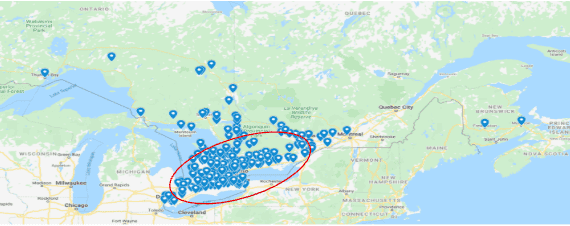
[image 1] Online learning expanded access across Ontario, reaching remote and northern communities previously underserved by in-person training. The red circle represents the geographic area from which most in-person learners historically participated.
These geographic barriers made it difficult for many municipalities, especially smaller or resource-constrained communities, to justify the cost of travel, accommodations and time away from work. Workforce realities such as shift work, seasonal demands and staffing shortages further limited participation in multiday, in-person sessions.
Municipalities needed a training model that was scalable, flexible and inclusive—one that could support everyone from frontline workers to senior leaders while helping organizations build internal capacity, meet compliance requirements and prepare for succession.
Solution
Designing Inclusive, Learner-First Experiences
In 2022, the Good Roads Education Department partnered with D2L to build a learner-first ecosystem designed to increase access, improve engagement and support long-term sustainability.
With a small team, Good Roads knew it needed more than just a platform.
“We wanted a partner that we could consult for guidance and support across all areas of our transformation—from instructional design to learner engagement strategies and content development. D2L gave us all that and more.”
— Eric Young, manager of education, Good Roads
To guide the work, Good Roads partnered with D2L Learning Strategy to analyze learner personas across its audience.
This analysis highlighted differences in technology comfort, literacy levels, connectivity, academic confidence and available time. Many frontline learners experienced test anxiety or had negative associations with traditional classroom learning.
“Many of our frontline learners suffer from test anxiety or have negative associations with classroom learning,” says Young. “It’s vital to support those personas and not just design courses for people who are happy studying in a traditional academic setting.”
To meet these needs, Good Roads redesigned its content to be more visual, written at a 10th grade reading level and structured into short microlearning units. Each unit takes five minutes or less to complete, helping learners stay engaged while balancing work and personal demands.
Expanding Access to Training
The team from D2L Learning Services worked with Good Roads to develop lightweight HTML content optimized for low-bandwidth environments. This ensured learners in rural and northern communities could access training reliably. All materials followed Universal Design for Learning principles to create an inclusive and consistent experience.
“Our partnership with D2L Learning Services allowed us to scale like a much larger team. From reusable course templates to robust analytics, we built a professional-caliber learning ecosystem that meets the real needs of municipal professionals across Ontario.”
— Eric Young, manager of education, Good Roads
Leveraging Interactive Learning With H5P
As learner needs evolved and engagement became a greater priority, Good Roads introduced H5P to create more interactive learning experiences.
“H5P interactives were set up to let learners apply knowledge to realistic scenarios in a safe, ungraded environment. Action-based learning helps build confidence and improve their ability to recall and apply processes and procedures on the job.”
— Eric Young, manager of education, Good Roads
The team used H5P activities to create more active, confidence-building learning experiences that reduced reliance on passive, text-heavy content [image 2].

[image 2] H5P interactives transformed passive learning into active, low-pressure skill development that built learner confidence, engagement and the foundation for practical application.
What started as simple activities—such as flip cards, image hotspots, crosswords and drag-and-drop exercises—quickly became a core part of the learning experience.
The team began using H5P more intentionally to address specific learner needs. Ungraded knowledge checks and fill-in-the-blank activities gave learners a low-pressure way to practice before assessments, helping build confidence and reduce anxiety. Visual and interactive formats reduced reliance on text-heavy content, making courses more accessible for a wider range of learners.
Scenario-based activities, including interactive video, helped learners apply knowledge in realistic municipal contexts. Learners could revisit activities and repeat them until they felt confident, reinforcing key concepts and supporting skill development.
H5P activities are accessible even in low-bandwidth environments so learners can access them, even in rural areas. Because H5P activities are built directly into Brightspace, learners can access everything in one place—without switching tools or logging in to separate systems—creating a simpler, more consistent experience.
This shift from static content to interactive learning reduced passive “click-through” behavior and encouraged deeper engagement, supporting stronger learning outcomes.
Delivery Flexibility With Multimodal Design
With a strong foundation in place, Good Roads introduced a multimodal delivery approach to improve flexibility and outcomes.
The flagship T.J. Mahony Roads School program, delivered in person for more than 50 years, was converted into asynchronous online courses while maintaining the same certification value.
“We’ve taken something that once took learners two years to complete through in-person sessions that can now be finished in as little as two weeks. Moving the courses online led to nearly a 50% increase in participation that year, resulting in the highest attendance in the program’s history.”
— Eric Young, manager of education, Good Roads
Blended formats were also introduced for leadership programs, combining virtual instructor-led sessions with asynchronous learning to balance flexibility and peer interaction.
To support this growth, Brightspace automation tools such as Intelligent Agents and release conditions helped streamline communication, personalize learning pathways and reduce administrative work.
“With limited resources, we needed a way to deliver sustainable, relevant programs at scale. Brightspace automations gave us that capacity, allowing us to focus our energy where it matters most—supporting learners and improving content.”
— Eric Young, manager of education, Good Roads
Results
Growing Beyond the Province
Good Roads’ online training catalog continues to grow, attracting more learners and expanding access to professional development across the sector.
Online enrollment has grown from 40 learners in 2022 to more than 550 learners annually, representing more than 10-fold growth. The program now reaches learners across Ontario, including remote and northern communities, as well as participants outside the province.
By adopting new tools and approaches, the education team was able to scale delivery without increasing staff while keeping programs cost-effective and sustainable. After an initial development phase supported by grant funding, the program became self-sustaining and now generates net-positive revenue.
Municipal employers have also seen clear cost savings. By removing travel, accommodation and backfill expenses, organizations save more than $1,500 per employee and can train more staff within the same budget.
“With just three staff and more than 180 volunteer instructors, we scaled from zero to nine online courses within two years and grew online enrollment 10-fold.”
— Eric Young, manager of education, Good Roads
Supporting learning success at scale required more than enrollment growth. It depended on creating clear, low-pressure learning experiences that kept learners engaged and progressing confidently through courses [image 3].

[image 3] Structured course design supported learner confidence, progression and successful course completion.
Increasing Learner Engagement and Satisfaction
Good Roads’ learner-centered approach delivered strong and measurable outcomes across engagement, completion and workforce skill development. Courses consistently achieve completion rates above 90% and assessment scores above 85%, reflecting both learner commitment and the effectiveness of the online learning experience.
Interactive H5P activities, structured course progression and low-pressure checkpoints helped learners stay engaged while building confidence and practical skills. Participants also report a 98% learner-reported skill improvement rate and strong employment outcomes, demonstrating how flexible, accessible online learning translated into meaningful real-world impact for municipal professionals.
Laying the Foundation for Long-Term Success
The transformation has helped Good Roads build a model that is both sustainable and scalable.
Today, the program operates as a self-sustaining model, with revenue reinvested into course development and continuous improvement.
Building on this foundation, Good Roads launched the Good Roads Instructor Training program to support instructors in delivering consistent, learner-centered experiences.
Looking ahead, the organization plans to expand its online offerings, increase course availability and build structured learning pathways for career progression.
“For more than 130 years, Good Roads has been committed to service and innovation. With D2L Brightspace, we’re leading a new era of professional development in the sector that is more inclusive, accessible and impactful than ever before.”
— Eric Young, manager of education, Good Roads
Together, Good Roads and D2L are showing what’s possible when thoughtful design, strong partnership and the right technology come together to expand access and improve outcomes for every learner.
