


Using Brightspace and Creator+, the ANA developed Decoding the Code, an immersive learning series that transformed ethics education through scenario-based learning, reflective activities, multimedia storytelling and interactive experiences grounded in modern nursing practice. The series helped nurses apply ethical principles more confidently in clinical environments while strengthening ethical judgment, patient advocacy and professional identity.
The initiative also transformed the ANA’s approach to course development by introducing a more agile and scalable Brightspace-native workflow, helping establish a modern model for ethics education that strengthened both learner engagement and organizational capability.
The Challenge
Bringing Ethics to Life in a Complex, Modern Care Environment
Ethical decision-making is the cornerstone of nursing practice, informing nurses’ interactions not only with patients but also with families, colleagues and the health care system itself. Since 1950, the American Nurses Association (ANA) has published the profession’s Code of Ethics for Nurses to guide the nearly 5 million nurses in the United States and to serve as a model for institutional and international codes. As the oldest organization representing registered nurses, the ANA supports a highly diverse nursing community across virtually every health care setting and specialty, including hospitals, long-term care, community clinics, academic institutions, leadership roles and public health environments. In addition to shaping professional standards and advocacy efforts, the ANA plays a critical role in continuing education and supporting ethical nursing practice nationwide.
Because the code serves as a foundational framework across such a broad and varied profession, the ANA faced a significant challenge—creating a learning experience that could resonate with both early-career nurses and seasoned professionals while remaining practical and relevant across dramatically different clinical realities and care environments.
Despite the code’s significance, however, many nurses struggle to translate its values into action.
It’s not difficult to see why this might be; codes of ethics can become easily bogged down in theory and jargon and do not typically provide an inspiring reading experience. Institutional and organizational attempts to teach the code have historically been static and text-heavy, often limited to solo study assignments or brief discussions during orientation sessions. While these approaches provide foundational knowledge, they rarely equip nurses with the deep understanding and practical judgment needed to navigate ethical challenges in real-world health care environments.
In 2025, the revision of the code—including the introduction of Provision 10, which addressed emerging considerations such as global health, environmental responsibility and artificial intelligence—created an opportunity for the ANA to fundamentally rethink how ethics education was delivered. Rather than asking learners to passively absorb theory, the ANA sought to create an immersive, practice-based learning experience that would help nurses confidently apply ethical principles in the realities of modern care.
The Solution
Designing an Engaging, Scalable Approach to Applied Ethics Learning
To address these challenges, the ANA reimagined ethics education from the ground up with a focus on practical application, reflection and real-world relevance. Rather than relying on passive, text-heavy instruction, the team sought to create an immersive learning experience that would help nurses actively interpret ethical challenges and apply ethical principles in practice.
Working collaboratively with D2L, the ANA developed Decoding the Code, a dynamic learning series delivered through Brightspace. The series was designed to help nurses engage more deeply with the Code of Ethics for Nurses through scenario-based learning, reflective activities, multimedia storytelling and interactive experiences grounded in modern nursing practice. Learners later described the scenarios as “very real and helpful to reflect on,” reinforcing the value of immersive, practice-based ethics education. [image 1]
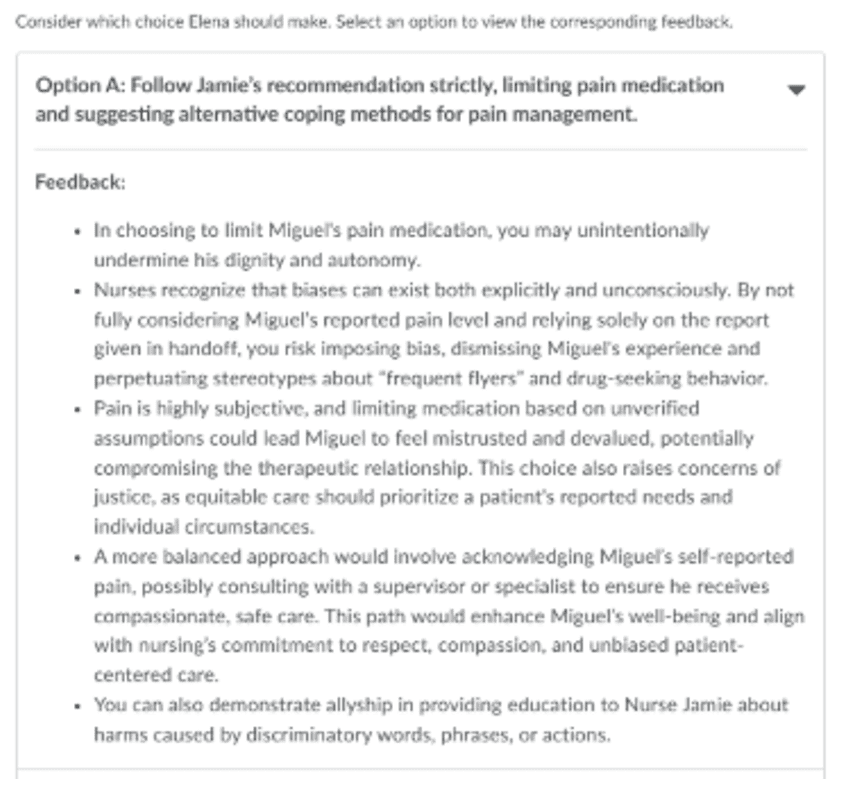
[image 1] Scenario-based learning placed nurses in realistic clinical situations where they actively navigated ethical decisions and reflected on potential outcomes.
The revision began with a needs analysis. Based on data showing that many nurses felt underprepared to navigate ethical challenges in practice, the team recognized the need for a more applied and reflective learning experience. Nurses needed more than theoretical instruction—they needed opportunities to work through realistic situations, reflect on difficult decisions and build confidence applying ethical principles in complex care environments.
Flexibility was also a priority. The learning experience needed to remain asynchronous to accommodate different schedules and professional responsibilities. With learners spanning a wide range of backgrounds and clinical settings, the experience also needed to balance broad relevance with practical application to individual nursing roles. Finally, the course needed multiple forms of media and interactivity to support different learning preferences and create an experience more engaging than traditional ethics education approaches.
To make the code more approachable and manageable for learners, the team broke the content into a series of courses—Decoding the Code—with one course dedicated to each of the 10 provisions. This modular structure created a more focused and immersive learning experience for each provision while also helping reduce cognitive overload and giving learners flexibility to focus on the topics most relevant to their practice.
The courses were rolled out in bundles. Provisions 1 through 3 focused on the nurse-to-patient relationship, Provisions 4 through 6 addressed the nurse-to-colleague relationship and Provisions 7 through 10 explored the nurse-to-society relationship.
The development of Decoding the Code represented one of the ANA’s most integrated cross-functional efforts to date. Content and scenarios for each provision were written by the ANA ethics team in collaboration with subject matter experts (SMEs). The ethics team also recorded videos used to humanize the code and to explain how the provisions function within a larger ethical framework.
Activities and provision-specific application examples were created first in partnership with the D2L team and later with the ANA’s internal course development team, which included a product manager, a nurse specializing in nursing professional development and instructional designers. Together, ANA SMEs, instructional designers, product teams and D2L collaborated through an iterative development process that combined ethics expertise, learner-centered design, multimedia storytelling and scalable Brightspace development. [image 2A, B, C]

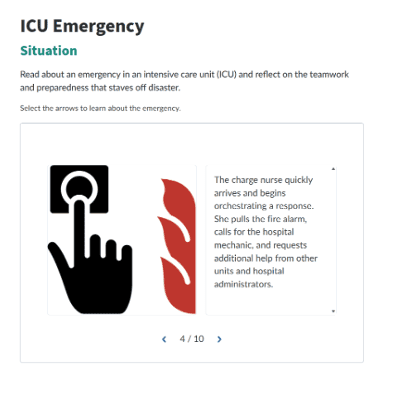

[image 2A, B, C] Creator+ elements helped transform dense ethical content into engaging, visually structured learning experiences.
To further reinforce the learning experience, the D2L instructional design team collaborated closely with the ANA’s ethics team to create a cohesive visual identity across the series. Custom illustrations and branded course elements were designed around the themes of each set of provisions, helping learners better understand the relationships explored throughout the Code of Ethics for Nurses while creating a more engaging and intuitive experience. [image 3A, B, C]


[image 3A, B, C] Custom illustrations and branded visual elements helped reinforce key ethical themes and guide learners through the Decoding the Code experience.
Illustrated visual maps were incorporated throughout the courses to help orient learners within each provision and reinforce the nursing relationships central to the learning experience.
Feedback loops between SMEs, designers and internal stakeholders helped ensure consistency, clinical accuracy and a cohesive learner experience across all 10 courses.
Throughout the courses, learners were encouraged to actively reflect on ethical complexity and moral distress through storytelling and interactive activities grounded in realistic nursing experiences. [image 4] One learner shared that the activities helped deepen their understanding of “what moral distress feels like: knowing the ethically right action to take but being unable to act due to constraints beyond my control.”

[image 4] Video-based storytelling immersed learners in realistic ethical situations, encouraging reflection on moral distress and helping nurses connect ethical principles to real-world decision-making.
The resulting experience transformed ethics education from a static compliance activity into a dynamic, practice-based learning experience that helped nurses engage more confidently with ethical decision-making in modern health care environments. As one learner described, the courses helped “put the words on the paper into action,” transforming ethical principles into practical guidance nurses could apply in their daily work.
The Result
Delivering Measurable Impact Across Learners, Teams and the Organization
The implementation of Decoding the Code transformed ethics education from a passive, text-heavy learning experience into an immersive and practice-driven approach that helped nurses apply ethical principles more confidently in real-world clinical situations. By combining scenario-based learning, reflection, multimedia storytelling and interactive learning experiences, the ANA created a more engaging and practical model for ethics education that strengthened both learner outcomes and organizational capabilities. The initiative not only improved learner success but also introduced more scalable and efficient approaches to course development while accelerating the ANA’s adoption of D2L solutions across the organization.
The most significant impact was seen in learners themselves. Designed to close the gap between ethical theory and clinical application, the series helped nurses build greater confidence navigating ethically complex situations and applying the Code of Ethics for Nurses more directly in practice. Overall, 93.1% of learners reported that the courses improved their nursing practice, while course materials received an average quality rating of 4.73 out of 5. This shift addressed one of the long-standing challenges in ethics education—helping learners move beyond theoretical understanding to confident application in complex clinical environments.
Learners consistently described the experience as engaging, relevant and immediately applicable to their daily work. One learner shared that the experience helped them “feel more confident advocating for patients in ethically complex situations,” while another described the scenarios as “very real and helpful to reflect on.” Learners also emphasized how the courses strengthened ethical decision-making in practice, with one participant sharing that the learning experience helped them “improve ethical integrity and decision-making in daily practice,” while another noted that the series “validated my practice and ability to mentor others.”
Nurses across the world consistently share how the modules help them ‘put the words on the paper into action’—making ethical principles tangible, relevant and achievable. Many describe feeling more confident advocating for patients, addressing moral distress and upholding the profession’s highest standards.Liz S., Ph.D., J.D., R.N. director of nursing programs and the Center for Ethics and Human Rights, American Nurses Association
As the courses rolled out throughout 2025, learner engagement remained consistently strong across the series. More than 1,486 nurses enrolled in the program, with 809 learners accessing at least one course and 587 learners completing courses to earn continuing nursing education credits. Learner satisfaction and recommendation scores further reinforced the success of the more immersive and application-focused learning approach, with the series achieving Net Promoter Scores of 76.1 for satisfaction and 77.8 for recommendation. Several provisions achieved exceptional learner response, including Provision 9 and Provision 10, which both received perfect scores of 100 for satisfaction and recommendation.
Beyond learner outcomes, Decoding the Code also transformed the ANA’s approach to course development. By implementing a Brightspace-native development model built around reusable Creator+ templates, modular course structures and scalable workflows, the ANA significantly improved production efficiency while maintaining a high-quality learner experience. Course development timelines were reduced from approximately 150 days to just 30 days per course, while production hours decreased by 62%. Across the full 10-course series, this resulted in 1,200 fewer projected development days, allowing teams to scale production more efficiently while maintaining consistency and learner engagement. These gains dramatically expanded the ANA’s production capacity while reducing resource strain and increasing the organization’s ability to deliver high-quality continuing education at scale.
The impact of the model was quickly seen beyond the ethics series itself. For example, the Nurses for Climate Action course [image 5A, B], which was originally projected to require approximately 150 development days and 278 production hours, was completed in just 20 days and roughly 117 hours using the new Brightspace-native workflow—an 87% reduction in development time and a 58% decrease in hours spent.


[image 5A, B] The scalable Brightspace-native development model significantly reduced production timelines and expanded the ANA’s capacity to deliver high-quality learning experiences more efficiently.
The success of the initiative also marked a significant shift in the ANA’s adoption of D2L solutions. Through Decoding the Code, Brightspace and Creator+ evolved from supporting development tools into core components of the ANA’s educational infrastructure, helping teams create more engaging, scalable and visually cohesive learning experiences across the organization. Learner response to the Brightspace experience was equally strong, with 4.6 out of 5 learners reporting high satisfaction with the platform.
The initiative also strengthened the ANA’s internal instructional design capabilities and established a scalable foundation for future learning innovation across the organization.
Working through the Decoding the Code learning modules deepened my understanding of how to integrate the Code of Ethics [for Nurses] into my daily nursing practice and strengthened my sense of moral and professional identity. As a member of a profession consistently recognized as the ‘Most Trusted,’ I was reminded of how essential the Code is, both in guiding my practice and in upholding our social contract with society.Beth P. R.N. CPHQ NE-BC
Together, the ANA and D2L transformed ethics education into a more engaging, reflective and practice-driven experience—one that better prepares nurses to navigate the evolving ethical realities of modern health care with greater confidence and clarity.
Interviewees:
- Michelle Rivers, senior nursing professional development specialist
