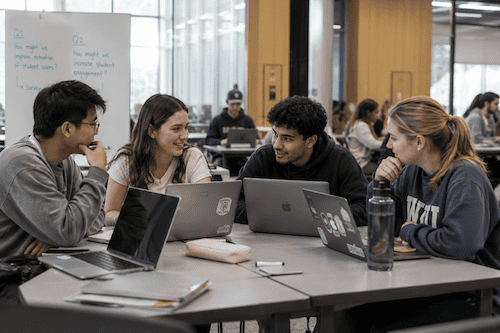
Welcome to The Education Exchange, a monthly newsletter exploring the ideas, questions, and conversations shaping education across K-20 and lifelong learning.
Each month, we’ll share a reflection on a timely topic, highlight a few conversations we’re following, and point you toward resources you may have missed. Our goal is not to cover everything happening in education. Instead, we aim to surface thought-provoking ideas, emerging trends, and practical perspectives that can help inform your work and spark new conversations.
When AI is built in, where does the decision sit?
Earlier this month, Google announced that starting in early 2027, Gemini and Google Search will be off by default for K-12 student accounts until school administrators turn them on. It’s the kind of control many school leaders have asked for, but the catch drew just as much attention. Search comes with AI Overviews and AI Mode built in, so a school that wants students to search the web without AI-generated answers has only one option: turn Search off entirely.
It’s easy to read this as a story about one company. But we think it’s more useful to read it as a preview. As AI becomes part of the tools that schools, colleges and universities depend on, every institution will face the same question: who decides how AI enters learning?
Three ideas seem worth holding onto:
- A switch is not the same as a choice: An on/off toggle settles a technical question, but educators are asking pedagogical ones. A teacher showing students how to evaluate sources may want search results without a synthesized answer sitting on top. A colleague down the hall may want AI support for a different task entirely. Real choice is granular. It lets decisions follow instructional intent by course, task, and role, rather than forcing an all-or-nothing call.
- Defaults are decisions, made by a human: Whatever a system does before anyone touches a setting reflects a person’s judgment about what learning should look like. That isn’t wrong in itself, but it should be visible. When features arrive bundled together, the people closest to students inherit choices they never got to make.
- Control means little without visibility: Choosing well requires knowing what a tool does with student data, where AI is at work, and who reviews what it produces. Trust in a technology partner can’t simply be claimed. It has to be shown, and open to checking through independent audits, clear documentation, and plain answers to hard questions. The aim is not to hand judgment to the machine, but to keep it with the people accountable for learning.
None of this argues against AI in classrooms. Used thoughtfully, it can give educators time back and help learners get support when they need it. The point is narrower and longer lasting. Decisions about when, where, and how AI shapes learning belong with educators and the communities they serve. Technology should make those decisions possible, not make them on educators’ behalf.
Jean Jarick, Manager, K-12, at D2L, takes a deeper look at why schools need meaningful control over how AI is introduced into teaching and learning, and why those decisions should be guided by educational goals rather than technology defaults. Read her blog here.
Conversations we’re following.
Across education, these are some of the ideas sparking discussion and debate.
AI training is growing. Ongoing support isn’t.
More teachers are getting AI training than a year ago, but most of it is still a single session. In an Education Week Research Center survey from earlier this year, 42% of teachers said they’d had no training at all on generative AI in the classroom. Only 9% said they were receiving ongoing professional learning.
The tools change every few months, and so do the questions teachers bring into class: how to design assignments, when AI helps, and when it gets in the way of learning. A workshop at the start of the year can’t keep pace with that.
Worth exploring: Why one-off AI training will not prepare teachers (eSchool News), by D2L’s Dr. Emma Zone and Dr. Cristi Ford.
Why it matters: AI readiness depends less on a tool rollout than on whether educators get the time, structure, and community to keep learning alongside it.
Workforce Pell arrives, slowly.
For the first time, federal Pell Grants can pay for short-term job training. Under Workforce Pell, programs of 8 to 15 weeks can qualify, and colleges must keep tuition in line with what graduates go on to earn. PBS calls it the largest expansion of Pell in 50 years, with an estimated 190,000 students a year eventually receiving about $2,200 each.
But the rollout is uneven. States have to name high-demand fields and approve programs before federal sign-off, and many colleges have found few existing programs that qualify.
Worth exploring: Workforce Pell Grants give students new options for job training (PBS News Hour)
Why it matters: It picks up where our October conversation on Gallup data left off. As public confidence in degrees falls, Workforce Pell pushes institutions to show the value of learning in shorter, more direct forms, and to measure it.
ICYMI
A few recent resources from D2L you may have missed.
Five Assumptions Worth Challenging in Higher Education
During a fireside chat at Ignite Canada 2026, John Baker and Dr. Ann Marie Vaughan reflected on how higher education is evolving in response to changing learner needs, new technologies and workforce demands. Building on that conversation, this article examines five assumptions institutions may need to rethink, from personalization and assessment to career preparation and continuous change.
The Learning Struggle Gap: Why Students Don’t Ask for Help, with Elizabeth Pearsall
On the latest episode of D2L’s Teach & Learn podcast, Elizabeth Pearsall of The American College of Financial Services explains why a student’s silence can be misleading. She covers the difference between productive and unproductive struggle, and how educators can build the psychological safety that makes asking for help feel normal since silence can be misleading. She covers the difference between productive and unproductive struggle, and how educators can build the psychological safety that makes asking for help feel normal.
Beyond the Deadline: Building Accessible Learning Experiences That Last
There’s still time to register for this upcoming EDUCAUSE webinar exploring how institutions can move beyond compliance-driven approaches to accessibility and create learning experiences that support all learners. Join accessibility leaders from D2L for practical strategies to build accessibility into course design, content creation and institutional processes for the long term.
Research Minutes: Two New Educator-Led Studies
This month, we’ve got two new Research Minutes to share. Dr. Stephanie De Souza explores how personalized automated messages can strengthen students’ sense of connection with their instructor, even in large lecture courses. Dr. Heather Horowitz and Alyssa Garnich share research showing that belonging in online learning is shaped less by technology itself and more by how educators use it to create trust, flexibility and human connection.
Building Empathy for Better Learning Outcomes
What changes when faculty experience online learning from a student’s perspective? Emma Lynch, Senior Director of Talent Capability and Learning Experience at Southern New Hampshire University (SNHU), shares how a six-week Brightspace program helps faculty build empathy and bring more inclusive practices into their teaching. The initiative has reached more than 500 faculty and 93,000 students, with reported improvements in student success, persistence, and assignment submissions. The program earned SNHU a 2026 D2L Excellence Award for its impact on teaching and learning.
The D2L Trust Center
Explore our new self-service hub for security, privacy, compliance and responsible AI information, including certifications, reports and sub processer updates, all in one place.
Your assignment
Consider the following question:
What’s one decision about AI in learning that you believe should always stay with educators?
Share your thoughts with us on LinkedIn.
Know someone who would enjoy The Education Exchange? Share this newsletter with a colleague and invite them to join the conversation.