TL;DR
- At D2L Ignite, John Baker and Dr. Ann Marie Vaughan challenged several assumptions that have shaped higher education for decades.
- Their conversation explored how institutions can rethink personalization, assessment and learner pathways in response to rapid change.
- The discussion underscored the importance of adaptability, human connection and lifelong learning in preparing learners for the future.
Are we at a point where we all should be reexamining many of the assumptions that have guided higher education for decades?
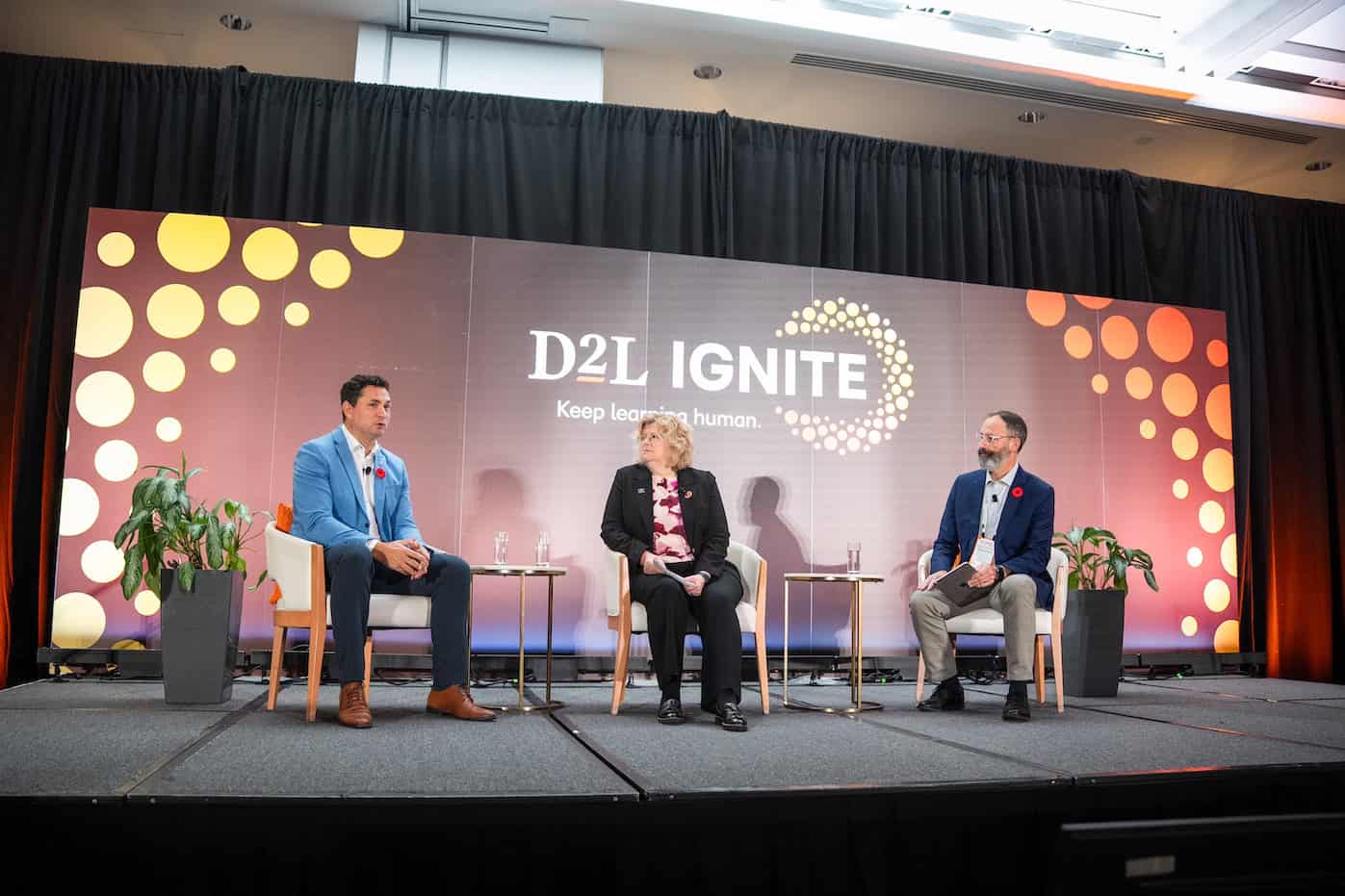
Following the recent announcement of a partnership between Humber Polytechnic and D2L to help reimagine teaching and learning, Dr. Ann Marie Vaughan, president and CEO of Humber Polytechnic, joined John Baker, founder, president and CEO of D2L, for a fireside chat at D2L Ignite. Their conversation explored a range of topics shaping higher education today, from workforce readiness and personalized learning to assessment and artificial intelligence. Running through the discussion was a larger idea: many of the assumptions that have guided higher education for decades deserve a second look
Here are five assumptions that institutions may want to revisit. Not because they’ve become irrelevant, but because the learners, careers and learning environments they’re meant to serve continue to evolve.
Assumption #1: Personalization is primarily a technology strategy
Conversations about personalization often focus on technology. Adaptive learning, artificial intelligence, and data analytics have certainly expanded what’s possible.
But technology alone doesn’t create meaningful learning experiences.
A recurring theme throughout the discussion was that personalization should ultimately strengthen human connection. Technology can help surface resources, automate routine tasks, and provide timely support, but the goal is not to replace relationships between educators and learners.
“I’ve been a big advocate of trying to position it as a human connection journey,” Baker shared.
If anything, technology should create more opportunities for coaching, mentorship, feedback, and engagement.
As institutions continue to explore AI-enabled learning experiences, maintaining that human-centered focus may be more important than ever.
What educators can do now
- Identify administrative tasks that technology can help streamline.
- Create more opportunities for meaningful instructor feedback and learner support.
- Measure learner engagement, belonging, and connection alongside academic outcomes.
Assumption #2: Assessment happens at the end
For generations, assessment has often been concentrated around exams, final projects, and end-of-course evaluations.
Artificial intelligence is prompting institutions to rethink that approach.
When learners can instantly access information and increasingly sophisticated AI tools, demonstrating learning may require more than recalling facts or completing a high-stakes assessment. Institutions are exploring approaches that place greater emphasis on authentic demonstrations of learning, continuous feedback, and practical application.
Alongside concerns about technology misuse, institutions are grappling with a deeper issue: how do we determine whether meaningful learning has taken place?
Projects, portfolios, simulations, and other forms of applied learning can help educators evaluate how learners think, solve problems, and apply their knowledge in realistic contexts.
“I think that leads towards more of a mastery-based model of education where we demonstrate not just results through one exam at the end of the journey. It’s demonstrated through many projects or many forms of assessment,” Baker said.
What educators can do now
- Increase opportunities for formative assessment throughout courses.
- Expand project-based and experiential learning opportunities.
- Review existing assessments to determine whether they measure mastery, application or primarily recall.
Assumption #3: Every learner should follow the same pathway
Many higher education systems were built around a relatively predictable learner journey. Students completed high school, enrolled in a post-secondary program, earned a credential, and entered the workforce. That model often assumed learners would follow a similar path toward similar outcomes.
For today’s learners, that path is often far less linear. Learners may stop and restart their education, switch careers multiple times, pursue credentials while working full-time, or return to education years after entering the workforce. Others arrive with valuable professional experience, military service, or industry certifications that shape what and how they need to learn.
As Dr. Vaughan noted, learners can have very different starting points while pursuing similar outcomes. “We’re moving away from this assembly line way to learn,” she said. Designing learning experiences that acknowledge those differences can help institutions better meet the needs of increasingly diverse learner populations.
What educators can do now
- Review admissions, transfer credit and prior learning recognition policies for unnecessary barriers.
- Explore more flexible program structures and pathways to credential completion.
- Consider where learner choice and flexibility could be increased without compromising quality.
Assumption #4: Education prepares learners for a job rather than a lifetime of learning
Traditional education models often assumed that learners were preparing for a specific profession that would remain relatively stable over time.
Today’s labor market tells a different story.
Rapid advances in technology, shifting economic conditions and evolving workforce needs mean that many graduates will move between roles, industries and even entirely new career paths throughout their lives. Learning is becoming less about preparing for a single destination and more about building the capacity to adapt.
Throughout the conversation, both speakers emphasized the importance of skills such as critical thinking, communication, creativity, resilience, and problem-solving. These capabilities help learners navigate change regardless of how specific technologies or jobs evolve.
“We have a responsibility to not educate or train students for a job or employment, but actually equip them with the skills, the adaptability, the resilience, and the knowhow to know that they’re committing to learning for life,” Dr. Vaughan said.
What educators can do now
- Embed durable skills alongside technical competencies across programs.
- Strengthen partnerships with employers and industry groups to better understand emerging needs.
- Help learners identify and articulate transferable skills they can carry across multiple roles and careers.
Assumption #5: Stability is the goal
Periods of disruption can understandably lead institutions to focus on preserving existing systems and practices.
But the conversation highlighted a different perspective: moments of change can also create opportunities to rethink how learning is designed and delivered.
From artificial intelligence and workforce transformation to changing learner expectations, higher education is operating in an environment where adaptation is increasingly part of the job. Rather than asking how to return to a previous state, institutions may benefit from asking what they can improve, redesign, or reimagine.
“I think this is the moment you actually lean in and help design the future,” Baker shared.
That doesn’t mean abandoning what’s working. It means being willing to examine long-standing practices through the lens of today’s learners and tomorrow’s needs.
What educators can do now
- Identify one policy, process, or practice that may no longer serve learners as effectively as it once did.
- Pilot small changes before pursuing large-scale transformation.
- Create space for experimentation, reflection, and continuous improvement across teams.
Looking beyond established assumptions
Higher education has always evolved alongside changes in society, technology, and the workforce. What makes this moment distinctive is the number of shifts occurring simultaneously. Learner expectations are changing. Career pathways are becoming less predictable. New technologies are reshaping how people access information, develop skills and demonstrate knowledge.
Against that backdrop, challenging assumptions isn’t about discarding everything that came before. Many of the practices and principles that have shaped higher education remain valuable. But some deserve closer examinations.
The fireside chat offers a useful reminder that innovation doesn’t always begin with new technology. Sometimes it begins with a simpler exercise: identifying assumptions that have quietly guided decisions for years and asking whether they still reflect the realities learners face today.
The answers may look different from one institution to the next. The opportunity lies in being willing to ask the question.
Challenging assumptions is often the first step toward improving learning experiences. For another perspective on how institutions can better support learners, listen to the Teach & Learn podcast episode with Elizabeth Pearsall, Assistant Provost for Teaching & Learning at The American College of Financial Services. Pearsall explores why many students struggle to ask for help and what educators can do to create environments that foster help-seeking, belonging, and student success.