
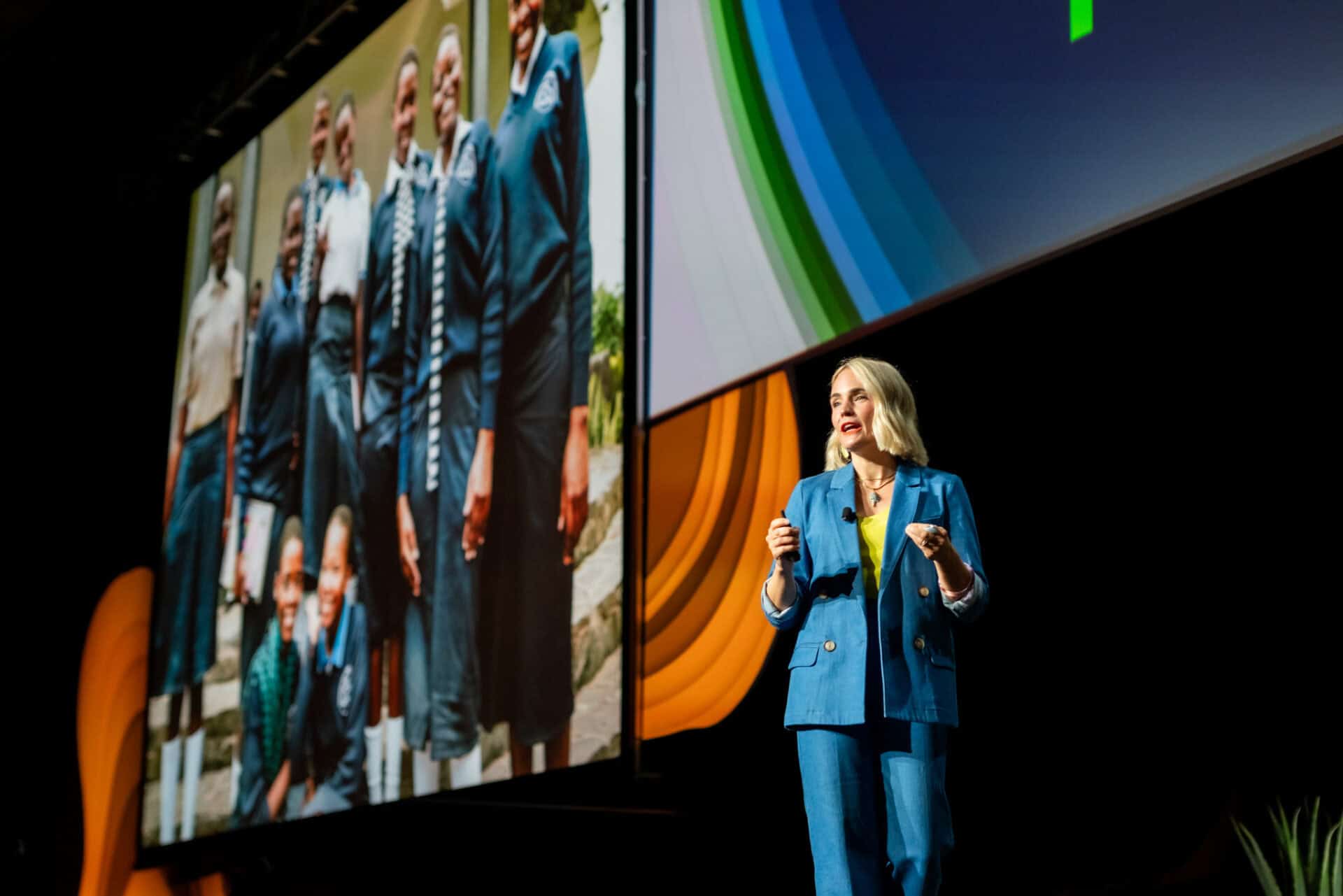
Years ago, I ran a women’s college in East Africa. It was some of the most meaningful and demanding work I have ever done. Each day, I saw what becomes possible when girls and women have access to education, opportunity and a community that believes in them.
So, as I listened to Liz Bohannon’s keynote at Fusion this year, I found myself transported back there. Her story of building opportunities for women in East Africa initially drew me in because it felt familiar. But what stayed with me was something deeper.
At a conference centered on education and technology, Liz invited us to consider one of the most human questions of all: How are we caring for our relationships with one another?
Her invitation was simple but powerful: What might change if we worked to become relationally rich? What if we became more intentional about our social health by paying attention to it with the same seriousness we give our physical health?
I loved what she invited us to consider and the way she reframed so many ideas we often take for granted. Her story was filled with insights worth sitting with. I encourage you to explore more of her podcast and writing, but for now, here are the four ideas I keep coming back to.
1. Stop Treating Resilience as a Solo Sport
We have turned resilience into a personal trait, something we are expected to grit our way through alone. When we can’t, we tell ourselves we aren’t strong enough or that we have simply allowed ourselves to become too burned out.
Liz offered a different way of thinking about it. Resilience is not only about becoming stronger as individuals. It is also about reinforcing the social scaffolding around us and cultivating the relationships that help us feel seen, supported and secure.
“Resilience doesn’t just exist within us as individuals. It’s about what exists between us. This is what I call collective resilience.”
She was also honest that this is slow work. Community takes time, intention and initiative. Often, it begins with choosing not to wait for the other person to reach out first.
2. There Is No Selfish Way To Pursue Healthy Relationships
Many of us in education treat our own relationships as an indulgence, something we will make time for after the real work is finished. Liz helped dissolve some of the guilt around that.
Becoming relationally rich differs from becoming financially rich in one important way. There is no way to grow richer in relationships without also enriching the lives of those around you.
Investing in your own connections is not a withdrawal from your work as an educator. It supports the work. We spend our careers trying to create environments where learners feel safe, supported and seen. We deserve those same things, and modeling what healthy connection looks like is part of how we create them for others.
3. Technology Can Give Us Back Time. Intention Determines What We Do With It
You might expect someone advocating so strongly for human connection to be wary of technology, and Liz named that tension directly. Some of the ways we use technology are contributing to the loneliness she described. But she resisted the easy conclusion that technology itself is the problem.
She shared a story she had never told onstage before. Ordering school supplies online saved her the two hours she would have spent driving three children from store to store. But the point was not simply that she saved two hours. It was what she chose to do with them.
She used that time to host a backyard back-to-school gathering, with each child bringing a new school supply and the parents gathering over coffee.
“This will only help us get socially healthy if we do it on purpose. It’s not going to happen accidentally.”
That is exactly how I’ve come to think about AI in learning. The point of giving an educator back time is really about what they reinvest that time into: feedback, mentoring and conversations that impact the learner. The time is the mechanism. The relationship is the point.
Left to accident, reclaimed time evaporates. Chosen on purpose, as Liz put it, the tools we fear will steal our humanity can become tools for reclaiming it.
4. Connection Is a Practice, Not a Personality Trait
Liz did not stop with why connection matters. She gave us a framework for putting it into practice, drawn from the habits she has observed in strong networks of support from Uganda and New Delhi to her own neighborhood in Oregon.
- Start with “I.” Relationally rich people take ownership of their social health in the same way many of us take ownership of our physical health. They initiate, again and again, without keeping score.
- Invest in rhythms and rituals. Deeper connection does not come from filling every opening on the calendar. It comes from protecting a few recurring commitments that matter. As Liz put it, “If you don’t date it, you won’t create it.”
- Ask better questions. Many of us say we dislike small talk, but we rarely take responsibility for moving the conversation somewhere deeper. Liz keeps question decks on her phone inspired by psychologist Arthur Aron and his colleagues’ “36 Questions,” a series designed to foster closeness, so she’s always prepared to steer surface-level chitchat into more meaningful conversations that leave a lasting impression.
- Treat conflict as a muscle. Relationships become stronger through rupture and repair, not by remaining safely on the surface. One of her most useful tools is a simple phrase: “Here’s the story I’m telling myself.”
It’s easy to climb the ladder of inference and construct an entire narrative about another person’s intentions. The practice is learning to notice when we are climbing and pausing before we reach the top.
Repair can be taught and practiced until it becomes normal. Most of us were taught to apologize and move on, sometimes allowing small hurts and unspoken assumptions to harden over time. Liz offered another way. When something lands wrong, name the story you are telling yourself. Ask before assuming. Make room for the other person to clarify what you may not be able to see.
The Image I Cannot Shake
Liz closed with the story of a storm that brought a 200-foot tree down on her house. No one was hurt. What stayed with me was that the tree fell across three households, which meant no single household had to absorb its full weight.
“When we share our joy, it multiplies. When we share our burden, the weight divides.”
Technology will continue to offer us new ways to reclaim time, and the evidence will continue to remind us that connection matters. But the question Liz left us with is the one I am still asking myself: What will we choose to do, on purpose, with the time and the people we have been given?
Feeling as though it’s all too much is not a flaw in your character. As Liz reminded us, we were never created to carry everything alone. That is not a weakness. It is part of what makes us human.
D2L Fusion 2027
Elevate What’s Next
Where people, ideas, and innovation come together to shape what’s next.
Denver, Colorado
July 27-29, 2027
Written by:


