
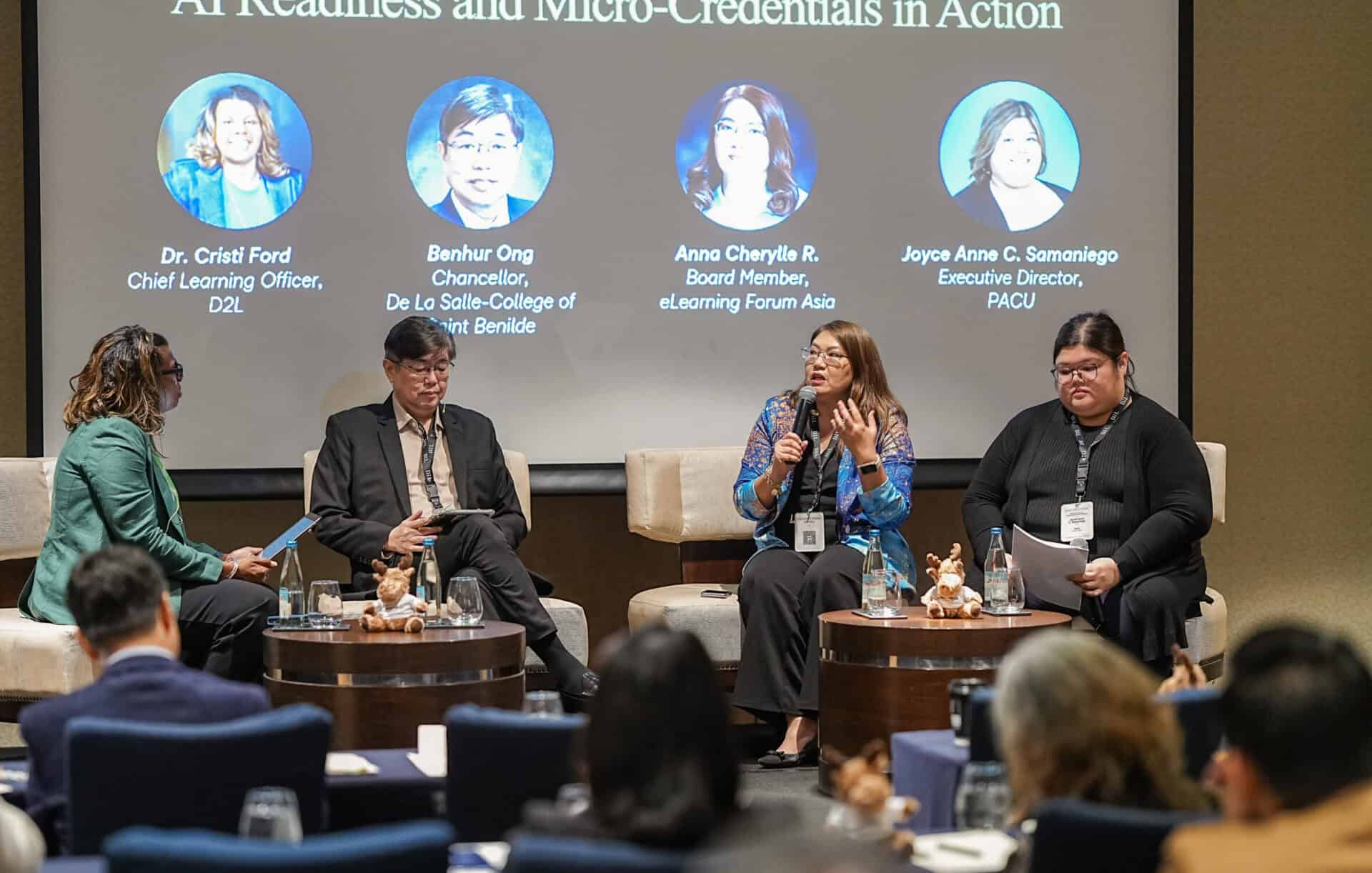
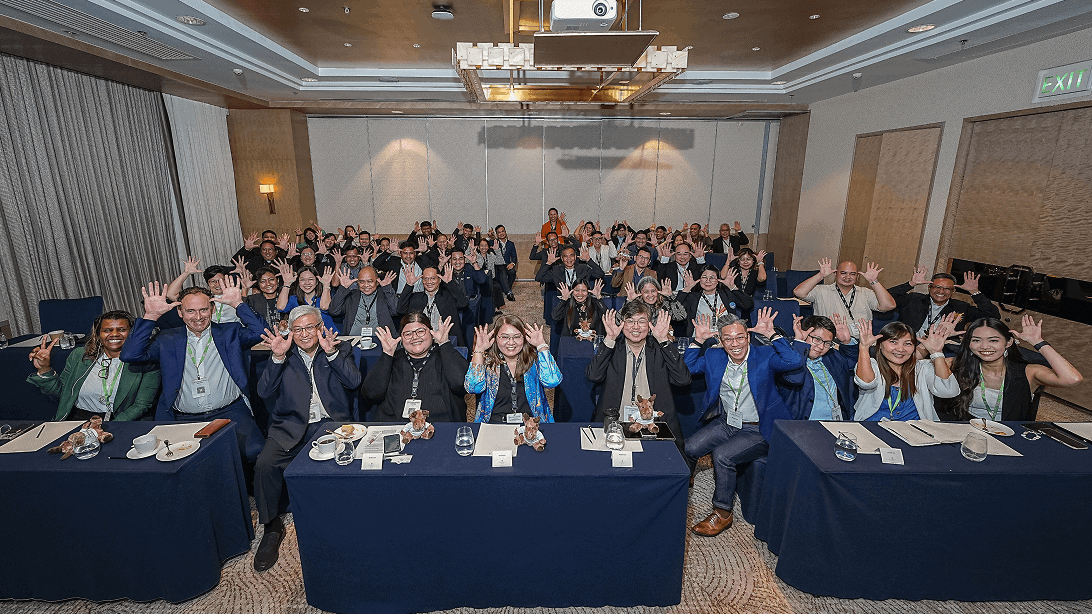
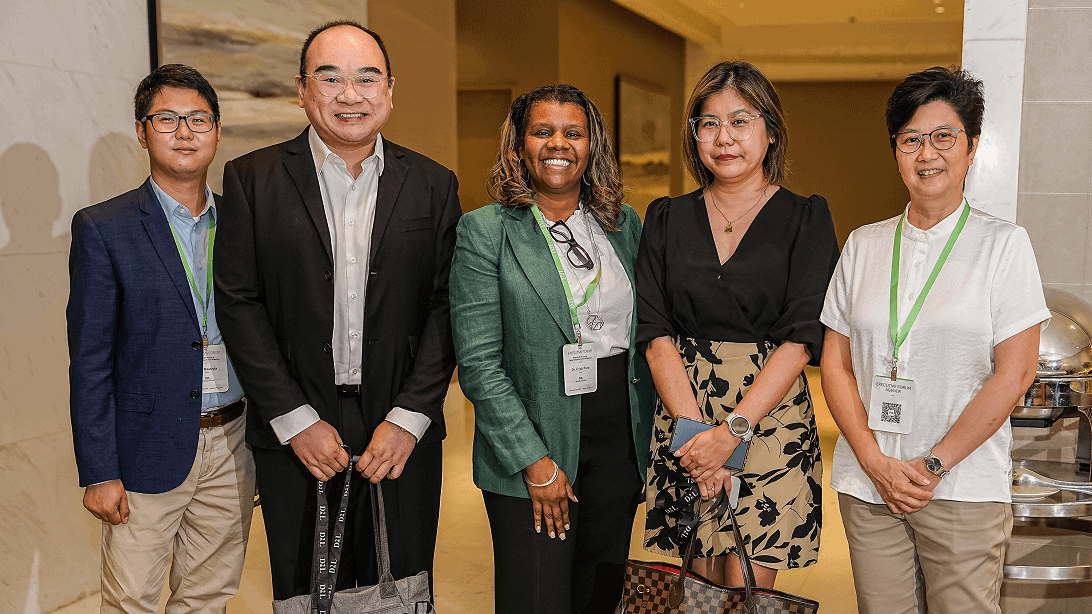
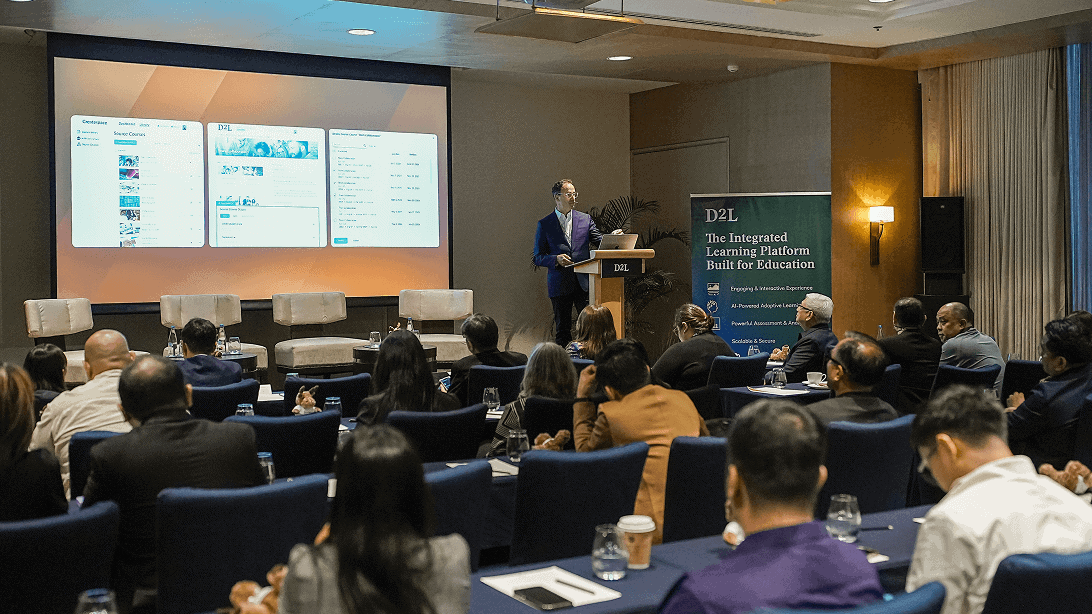


At our recent Executive Forum in the Philippines, we were lucky to welcome a panel discussion with prominent thought leaders in the field of higher education.
The session, “Shaping the Future of Higher Education in the Philippines: AI Readiness and Micro-Credentials,” was led by Dr. Cristi Ford, Chief Learning Officer at D2L, who was joined by:
- Mr. Benhur Ong, Chancellor, De La Salle–College of Saint Benilde
- Asst. Professor Anna Cherylle Ramos, Board Member, eLearning Forum Asia
- Ms. Joyce Anne C. Samaniego, Executive Director, Philippine Association of Colleges and Universities Inc. (PACU)
Together, they tackled pressing questions around AI adoption, micro-credentialing, and the future of higher education, offering practical insights from both regional best practices and the Philippines’ evolving national strategies.
Integrating AI Into Education: From Regional Models to National Strategies
The panel opened with a call to action: AI adoption cannot wait.
“If I’m at a school and I’m not looking at this technology right now, I would be really worried because it’s not going to go away. It’s actually going to get better. If we don’t teach our students, they will be left behind,” Mr. Ong stressed.
Panelists then dove into the transformative potential of AI in Philippine higher education. Regional best practices from eLearning Forum Asia were shared by Asst. Professor Ramos, who emphasized how Singapore and Malaysia have advanced national AI strategies with clear policy frameworks, funding structures, and industry-academia partnerships.
“The game changers are those countries with very organized, very coordinated national AI strategy plan,” said Asst. Professor Ramos. “In Singapore, they launched in 2003 their AI strategy plan 2.0 and they identified the education sector as a key strategic partner. Malaysia also instituted their national AI office and this is the coordinating agency that will align the government, the academia and the industry together.”
In contrast, the Philippines still faces fragmented adoption, with innovations happening in pockets rather than through coordinated national direction.
Ms. Samaniego also went into details on the AI initiatives PACU is using to support its 190 member institutions, including webinars, a manual of acceptable use in AI, and its partnerships with the Information Technology Association of the Philippines to align curricula with industry needs. The democratization of AI technologies through consortium models was also addressed. For example, national associations like PACU can support smaller institutions by creating consortium-based partnerships that provide affordable access to AI technologies and resources that individual schools couldn’t afford alone.
“It’s important to have that grand vision from above, and then you have the grassroots energy down below,” explained Ms. Samaniego. “When you combine them together you evolve from something like an experiment to a national transformation.”
The panelists spoke about data integrity and how institutions implementing AI and learning analytics must establish compliant data governance models early. Institutions must also balance AI innovation with rigorous quality assurance backed by real data and learning analytics to build credibility and trust with students, employers and accrediting bodies. Establishing strategic AI policies will also be paramount.
“You have to set your AI policies first. You have to take into consideration your school’s values, your school’s objectives,” said Mr. Ong
The CHED Framework and The Role of Micro-Credentials
The discussion then turned to micro-credentials, an area where the Philippines is moving quickly.
The new CHED Memorandum Order on micro-credentials provides clear guidelines for institutions to offer certified programs, including partnerships between HEIs and non-HEI providers, creating new opportunities for lifelong learning markets.
“The new CMO has now clearly defined the playing field. They have outlines of what you need to do, what processes you need to take so that you can get a license to offer micro-credentials not only for your own school, but also externals,” said Mr. Ong.
It was noted that some institutions are opening micro-credential offices, including Our Lady of Fatima University, Panpacific University, and Mapúa. Asst. Professor Ramos highlighted Singapore’s SkillsFuture framework and Taiwan’s Adaptive Learning Platform as benchmarks. “Taiwan adopted the Taiwan Adaptive Learning Platform. Quality metrics were already embedded at the design stage, so the platform could provide personalized feedback, similar to what D2L Lumi is capable of,” shared Asst. Professor Ramos.
Mr. Ong then emphasized the revenue potential of micro-credentials. “When you build micro-credentials, it’s not just for undergraduates. You’re opening a new market for lifelong learners and even bringing your alumni back,” he said.
AI and the Future of Higher Education
Looking ahead, the panelists envisioned a future-ready Philippine education system powered by AI and precision education by 2030.
“We’re trying to build a new data warehouse so we can look at what makes our students get hired faster, graduate on time, or perform better in board exams. Innovation is nothing without credibility and trust, and that trust comes from real data,” noted Mr. Ong.
Data governance was also underscored to be essential for compliance with privacy laws and effective analytics use. When it comes to preparing teachers to be future-ready, AI competency training was identified as being foundational.
The upcoming Second Congressional Commission on Education report will outline a National Education and Workforce Development Plan, which will prioritize sectors like advanced manufacturing, healthcare, AI, hospitality and tourism. The speakers called for a shared platform where different innovations could come together, helping institutions make the most of their expertise. Their vision is to build an education system by 2030 that’s powered by AI, driven by precision, and focused on equity.
As the session ended, the speakers reminded the audience of the rapidly evolving educational landscape pushing the need to stay competitive and relevant through embracing AI, strengthening micro-credentialing and fostering collaboration. While countries with fragmented institutional innovations limit overall impact, those with organized, coordinated national AI strategies see the most significant educational transformation.
“If we can set a grand vision and then converge as brilliant State Universities and Colleges and private institutions, we can pool our resources without stifling creativity. In fact, convergence can amplify it,” said Asst. Professor Ramos.
Key Takeaways from the Panel
The discussion surfaced a set of actionable insights for Philippine HEIs and policymakers:
- AI adoption cannot wait. Institutions that delay will lose competitiveness as AI continues to advance rapidly.
- Data governance is foundational. Without robust, compliant data models, AI and learning analytics will fail to deliver impact.
- Consortium models democratize AI. National associations like PACU can level the playing field by enabling collective access to AI technologies.
- Micro-credentials open lifelong learning markets. When properly implemented, they can re-engage alumni, serve professionals and generate new revenue streams.
- Regional best practices show the way. Singapore’s SkillsFuture and Taiwan’s Adaptive Learning Platform offer proven models for embedding quality assurance and personalization.
- National coordination is key. Countries with unified AI strategies see the greatest transformation. The Philippines must move beyond fragmented institutional efforts to coordinated action.
- Innovation without trust fails. AI-enabled education must be backed by real data, quality assurance, and stakeholder confidence.
The insights from our Executive Forum made one thing clear. The future of higher education in the Philippines depends on acting with urgency, embracing AI, and building systems of trust and collaboration.
But how do institutions move from strategy to practice? What are the practical steps to harness AI in ways that deliver measurable impact for both educators and learners?
We invite you to explore these questions further in our upcoming webinar.
Efficiency Meets Impact: The Power of AI in Your Learning Platform
October 15, 2025
2:00 PM PHT
Written by: