
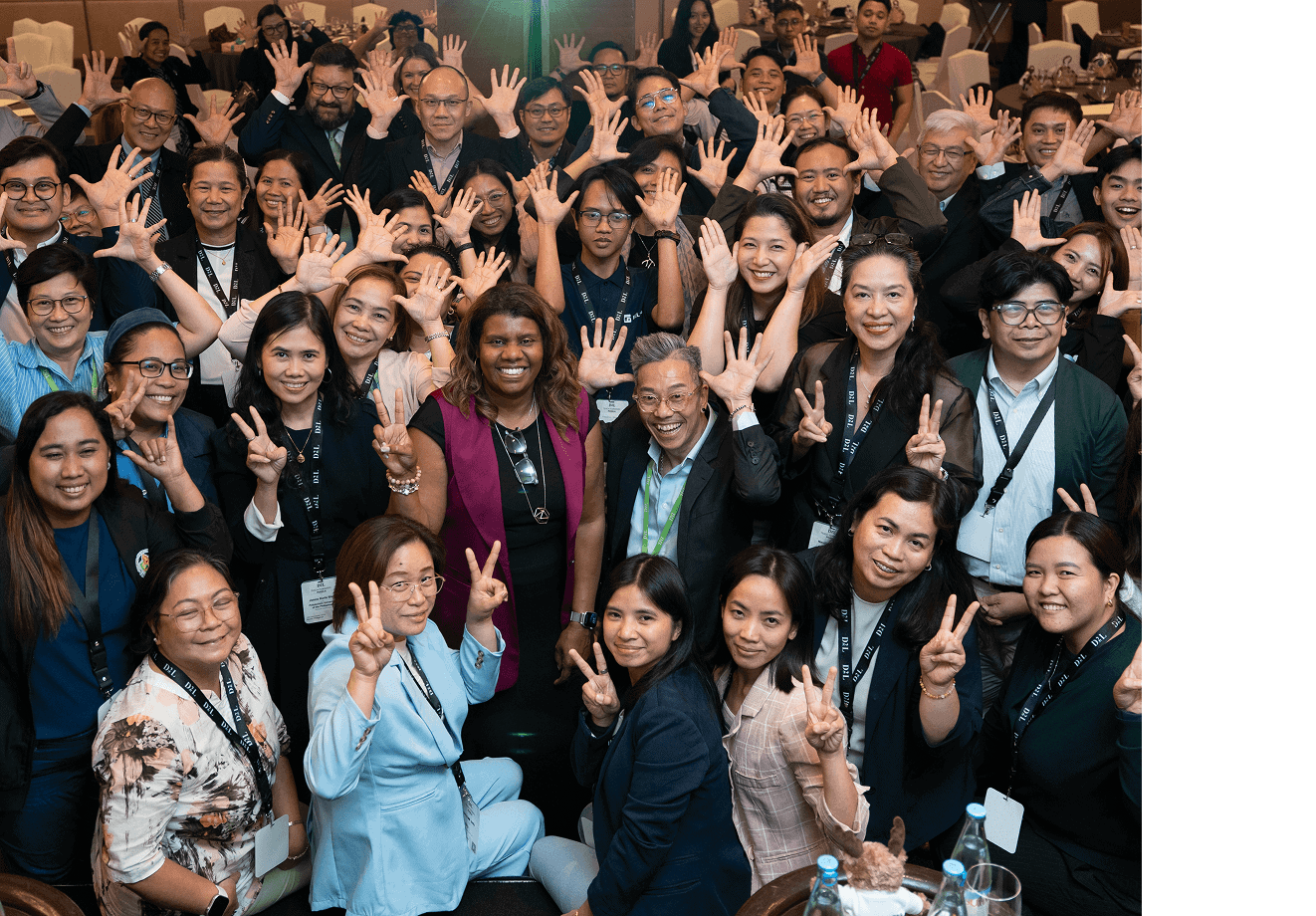
On September 14, D2L welcomed academic leaders and faculty from Philippine higher education to Makati Shangri-La for Teach Forward Manila, where much of the program centered on AI in teaching and assessment and on making the national micro-credential framework work in practice. Two panels moderated by Dr. Cristi Ford, D2L’s Chief Learning Officer, brought university, industry and student voices together, while a keynote and a case study from Singapore showed skills-based credentials already at work.
Different as they were, the sessions kept returning to one question: what counts as credible evidence of learning, and who should judge it? Here is what we took away.
Keep faculty judgement at the center of AI
Faculty hesitation about AI is easily misread as a fear of change. The opening panel suggested institutions ask instead: what are faculty trying to protect? The answer may be practical, such as unfamiliar tools and little time to adapt, or pedagogical: students should think first before they use AI.
Guardrails for ethics and integrity still matter, but “consistency is different from uniformity,” as Dr. Arturo J. Patungan Jr. of the University of Santo Tomas put it. AI use should follow the competency being assessed. In a statistical modeling assignment that assesses model selection and interpretation, using AI to write the code or generate visualizations is acceptable, whereas in a task that assesses programming syntax and logic, it is inappropriate.
Assessing reasoning over artifacts
Polished essays and working code say little about learning on their own, because AI produces them easily. Learning becomes visible when students can explain their choices. Dr. Patungan proposed replacing a yes-or-no declaration with questions such as:
- Where, and at what stage, was AI used?
- What did it suggest?
- What did you change or reject, and why?
Making honest disclosure safe
Adriel Cid C. Tandoc, a student at De La Salle-College of Saint Benilde, described his college’s four-level AI policy, which runs from no AI use to AI as co-creator. Instructors set the permitted level for each task, and students declare their use at the top of each submission. His analogy: AI that helps you learn is a bicycle you still have to pedal, while AI that does the work is a taxi ride.
Disclosure depends on trust. The panel discussed a student who received a zero for honestly declaring AI use in a class with no clear guidelines, while classmates who stayed silent went unpenalized. The remedy proposed was to listen to faculty and students first, gather evidence from classrooms already redesigning assessment, give faculty time to do that work, and revise guidance as the tools change.
Make credentials keep pace with work
The central constraint on credentialing today is relevance latency: the time between work changing and credentials reflecting that change. Dr. Samson Tan, Chief AI Officer at Singapore’s Institute for Adult Learning (IAL), noted that AI changes work at the task level, so the job title persists while the task mix beneath it turns over continuously. Degrees keep their value, but they are static, say little about specific capability, and lag behind demand.
His proposal keeps qualifications and builds a faster, evidence-rich skills layer alongside them:
- Articulate: Define granular, observable capabilities in a common skills language
- Activate: Demonstrate skills through authentic work, evidence and reflective professional judgment
- Recognize: Convert verified competence into portable, trusted signal that influence opportunity
In IAL’s model, practitioners in Singapore’s training and adult education sector can earn digital skills badges for capability built at work, through a portfolio of practice artifacts and reflections weighed by assessor judgment, a competency interview and independent review. But badges have a reputation problem, Dr. Tan acknowledged, since anyone can issue one but very few can defend one, so their credibility rests on the chain beneath them: common standards, evidence of practice, dialogic validation, and quality assurance.
AI belongs in the machinery of credentialing, sensing task-level change, translating demand into descriptors and rubrics, surfacing workplace evidence and learning from outcomes. Any such use must remove the burden, not the bar, and judgment of competence stays with human assessors. He suggested five moves to begin:
- Choose one fast-changing capability domain.
- Build an AI-enabled demand-sensing loop.
- Define granular skills and authentic evidence.
- Pilot a human-governed, portfolio-based credential.
- Secure employer recognition before scaling issuance.
Micro credentials that employers can trust
The Philippines now has a national policy for micro-credentials. The afternoon panel asked what it will take for them to be valued by learners, backed by institutions and trusted by employers.
Universities described how they build in rigor:
- University of the Philippine Open University sets a minimum of 0.5 units, around 16 to 20 hours of interaction excluding assessment, and advocates co-developing, co-delivering and co-assessing programs with industry, Dr. Finaflor Taylan explained.
- Mapúa University pairs a rigid degree core with a fast layer of stackable, industry-linked micro-credentials and has awarded more than 360,000 badges to students and alumni, Dr. Dodjie Maestrecampo noted. Industry partners confirmed employment advantage, and an evidence portfolio in Mapúa’s credential architecture supplies the proof employers look for.
- Singapore Institute of Technology grades authentic, performance-based tasks against criterion-based standards, so that an “excellent” corresponds to quality industry recognizes, Dr. Eric Chua explained. Rather than wait for a perfect system, the university launched its stackable pathway early and has refined it through iteration, with extra support for its first learners.
Martha Singson, VP of People Operations at Salmon Bank, framed the task as operationalizing trust. She urged employers to write job descriptions from scratch, confirm capability through probationary assessments, and address pay equity between credentialed and experienced staff.
Accountability, the panel agreed, is shared:
- Government as prime mover, providing infrastructure, standards and convening a national multi-stakeholder consortium
- Industry communicating its evidence requirements, building credentials into hiring and pay, and giving employees time to study
- Academia listening to industry, developing soft skills alongside technical competence, and supporting graduates after the credential
Rebuilding the degree around competencies
The Singapore Institute of Technology (SIT) has adopted competency-based education as a university-wide pedagogy and, in response to skills mismatch, built a set of degrees from stackable micro-credentials of 18 ECTS credits each, with recognition of prior learning that credits working adults for what they already know.
Its Competency-based Stackable Micro-credential (CSM) pathway launched a degree in Applied Computing in 2023, followed by Electrical and Electronic Engineering and Infrastructure and Systems Engineering in 2024, with 23 micro-credentials and more than 700 learners to date. The first cohort, in Applied Computing, was due to graduate in October 2026.
Dr. Eric Chua, Director of the SIT Teaching and Learning Academy, described how the model works in practice:
- Turning the curriculum “90 degrees.” Instead of building from Year 1 foundations to a final-year capstone, each engineering micro-credential incorporates the fundamentals it needs, taught just-in-time. Learners who stop partway keep the micro-credentials they have completed.
- Pairing flexibility with support. Largely self-paced content runs on D2L Brightspace alongside weekly synchronous sessions. Non-academic success coaches help with goals, learning plans and well-being, and learners who fall behind receive both automated nudges from the LMS’s intelligent agent and personal ones from their coach.
- Keeping validation human. AI can assist with seven of the eight steps in SIT’s micro-credential curriculum development process. Step five, job-level validation with industry experts, however, should not simply be handed to AI.
Looking ahead
Across these sessions, speakers held learning to a demanding standard: it has to be visible in what a person can explain, defend and carry into work. As Dr. Tan put it in his closing, policy can open the door, but institutional capability determines whether anyone walks through it.
Our thanks to everyone who joined us in Makati. To see where D2L is headed next, visit our events page.


