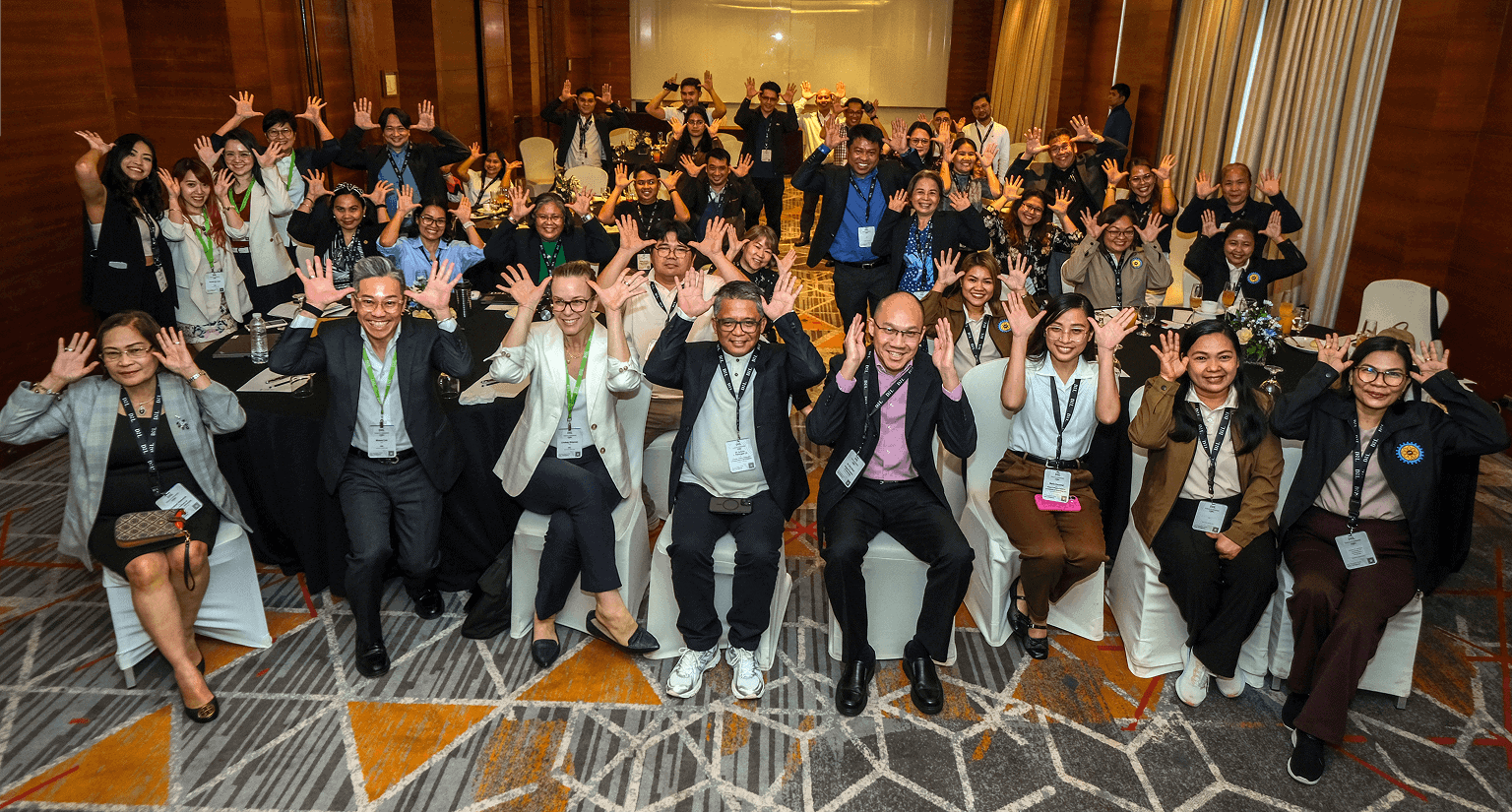
On November 17, D2L brought higher education leaders from across the Visayas to Radisson Blu Hotel, Cebu, for D2L’s Teach Forward Cebu. The program examined AI in teaching and assessment and the move from micro-credential policy to practice.
A common concern emerged: what a grade or credential certifies, and what evidence lets an institution stand behind it. Here are some key takeaways:
Make student thinking visible
In his keynote, Dr. Arturo J. Patungan Jr. of the University of Santo Tomas asked: when AI produces polished answers, how can we make student thinking and learning visible?
He framed the problem with a familiar dilemma. A student submits a polished paper and discloses that AI helped produce it. Should it earn a top score, require an oral defense, or lose marks simply because AI was used? When instructors in one program answer differently, the institution is exposed: “A grade is a teacher’s judgment. However, the grade communicates something about the institution.“
His answer began with purpose. At work, repetitive tasks are automated for efficiency. In education, repetitive practice builds capability. Institutions must decide which practice to keep, redesign or retire.
From there came his framework of delegate, verify, own.
- Delegate: Define, course by course, what AI may and may not do.
- Verify: Collect evidence of learning in proportion to what the grade claims.
- Own: Keep students and institutions responsible for submitted work and automated outputs.
Verification is harder than it looks, he warned, citing a fluent ChatGPT calculus solution that beginning students could not recognize as wrong. Assessment must also distinguish producing from performing, since a strong AI-assisted report shows what a student can deliver rather than what they can do alone. Disclosure has the same limit. “A student can disclose accurately and still not understand the work,” he noted.
Conversely, a weak oral performance does not in itself prove misconduct; nerves, introversion or language barriers may explain it. A student who uses permitted AI, discloses it, then falters under questioning has broken no rule. Under CHED Memorandum Order No. 21, which governs AI in Philippine higher education, a detector’s result cannot serve as sole proof.
That answers his opening dilemma. The paper earns credit for its quality, with no penalty for AI use, and the student’s independent ability is assessed separately against criteria published in advance.
Make micro-credentials meaningful beyond the campus
In a fireside chat, Lindsay Shipman of D2L and Dr. Eric Chua of the Singapore Institute of Technology (SIT) compared approaches across borders. The Philippines, Lindsay noted, is moving from policy to implementation under CHED’s guidelines. Singapore pairs a uniform Ministry of Education definition with largely institution-specific implementation, while Canada and the US allow greater local variation.
Three lessons emerged:
- Use shared descriptions. Lindsay proposed shared descriptions of outcomes, assessments and pathways so that a credential’s value is clear beyond its issuer.
- Triangulate industry evidence. To keep content relevant, SIT draws on Singapore’s SkillsFuture framework, job-posting data and employer validation.
- Address barriers beyond fees. Singapore subsidizes eligible learners heavily, yet Dr. Chua called fees a “hygiene factor”: necessary, but no guarantee of participation. Learners also weigh time away from work and lost income.
Rethink degrees from stackable micro-credentials
Dr. Chua traced SIT’s shift to competency-based, stackable micro-credentials, a response to the skills mismatch between academia and industry. Since 2023, SIT has launched degrees on a model with four building blocks:
- Competency-based education. Each outcome integrates knowledge, skills and abilities, “the coming together” of what someone knows and can do.
- Micro-credentials. Each carries 18 ECTS credits (450 notional hours over 12 weeks) and covers three or four competencies.
- Stackability. Learners can take micro-credentials and stack them toward a bachelor’s or master’s degree
Recognition of prior learning. Exemptions recognize competencies from formal qualifications, industry certifications, in-house training or work experience shown in a portfolio.
Design starts from the competencies graduates need. Instead of progressing from Year 1 foundations to specialized topics, SIT consolidates relevant content from all four years into self-contained micro-credentials such as Engineering Design and Solutioning.
Support is also there, designed for completion. Largely self-paced learning on D2L Brightspace is paired with a weekly synchronous session that builds community among learners. Non-academic success coaches help learners balance work, life and study, while analytics run from pre-course profiling to post-course review. AI also with assist curriculum development, but job-level validation with industry experts remains human.
Looking ahead
Together, the sessions suggest that credibility is built before work is submitted. As Dr. Patungan concluded, credible grades need clear outcomes, fair process and the resources to apply them.
Our thanks to everyone who joined us in Cebu. To see where D2L is headed next, visit our events page.